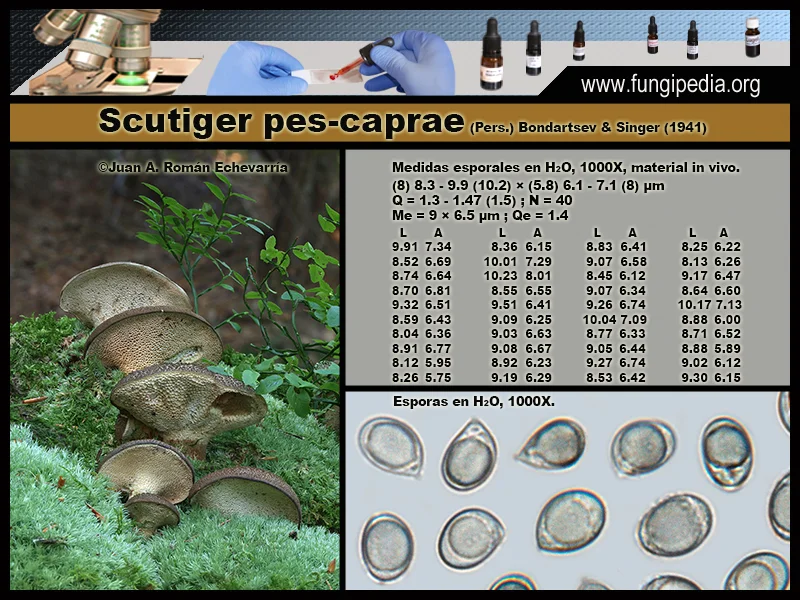

Scutiger pes-caprae
Taxonomy
Main synonym
Common names
Pie de cabra, ahuntz-apo.
Geographic references:
Interactive map with data from GBIF.
Morphological Features:
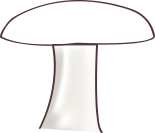
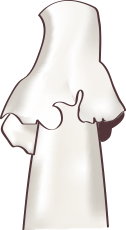
Pileus that can reach notable dimensions, potentially exceeding 10 cm in diameter, with a goat-hoof or kidney shape, sometimes simply semicircular. It is quite uniformly brown in color, and its surface is very dry and scaly in young specimens, but over time it gradually cracks, eventually revealing the color of the flesh beneath the pileal surface. This cracking typically occurs in plates and affects the entire surface, perhaps except for the margin. This margin is incurved when young and later becomes thin, not excessively undulate.
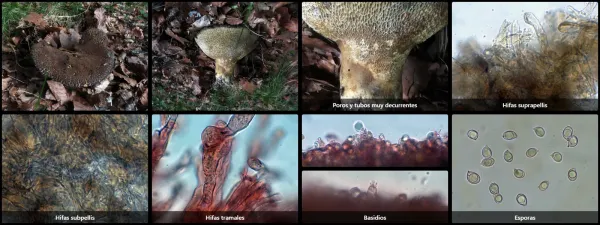
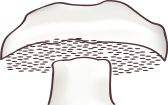
Hymenium composed of tubes and pores; the former are very short and white in color, though they gradually take on a yellowish tint with age, decurrent quite markedly onto the stipe. The pores are broad, almost always hexagonal, easily visible, measuring 1 to 2 mm per pore, which is a large size, not typical for poroid species. They are initially white, then yellowish, and somewhat ochre when old.
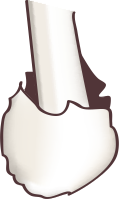
Stipe eccentric or more typically lateral, proportionate or shorter than the diameter of the pileus, with a highly irregular shape, twisted and deformed, generally thicker at the base. It is hard and solid even when old, and although whitish when young, it soon becomes yellowish-ochreous, distinctly brown on the lateral extension of the pileus.
Flesh thick, white or yellowish in color, fibrous and somewhat hard but brittle. It has a pleasant, faint odor, and its taste is sweet, reminiscent of nuts.
Habitat:
It is an infrequent species that appears mainly in late summer and early autumn. Unlike most Polyporus species, it is terrestrial rather than lignicolous, and we typically find it exclusively in beech forests, always in steep or rugged terrain.
Observations:
Unfortunately, it is a choice edible, distinct in texture from any other mushroom, and we say unfortunately because this species is on the Red List of seriously endangered species across virtually all of Europe, so we do not recommend its consumption. Otherwise, we consider it a readily recognizable species, characterized by its peculiar goat-hoof shape and the yellowish tones of the pores and stipe. Other terrestrial poroid species are completely distinct, such as Albatrellus subrubescens, which is white above, or Albatrellus ovinus, which has a greenish hue.
Microscopy of Scutiger pes-caprae