
Scutellinia trechispora
Taxonomy
Main synonym
Common names
Betiledun.
Geographic references:
Interactive map with data from GBIF.
Morphological Features:
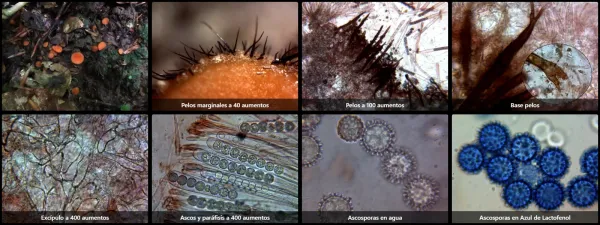
Fruiting body of reduced dimensions; many of the specimens found did not reach half a centimeter in diameter, and the most developed ones did not even reach one centimeter. They have a rounded and cushioned shape, generally quite regular, resembling a soft button. The external surface is orange or reddish in color, but it is covered with brownish hairs that impart this coloration; these hairs appear especially long and conspicuous at the margin, although they are present over the entire surface.
Hymenium immersed in the internal surface of the ascocarp, uniformly dark orange or reddish in color, and shiny. It is completely smooth, lacking the hairs found on the external portion.
Stipe absent; this is a sessile species.
Flesh scant and fragile, of the same color as the rest; neither its odor nor taste is noteworthy.
Habitat:
This species appears from spring through late autumn, typically on moist soil, and we believe it is associated with some type of bryophyte; we have never observed it on wood. It is not particularly common, but when located, it is usual to find a large group of specimens.
Observations:
This is a small-sized Ascomycete with a discoid shape and a striking reddish color, characterized by brownish hairs that are highly conspicuous at the margin. It is practically impossible to distinguish one Scutellinia from another without resorting to microscopic analysis. This particular species is distinguished by its specialized spores, which are globose and verrucose, with very pronounced ornamentation, almost spine-like. Scutellinia scutellata is the most well-known species in the genus, but it possesses elliptical spores and also fruits on decaying wood.