Scutellinia scutellata
Taxonomy
Main synonym
Common names
Betiledun.
Geographic references:
Interactive map with data from GBIF.





Morphological Features:
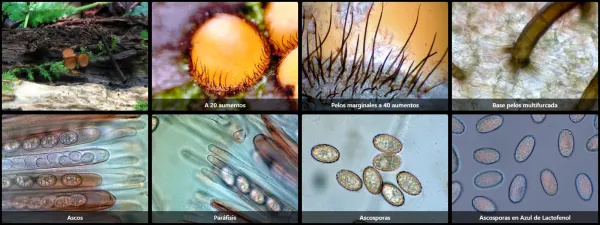
Carpophore very small, its diameter rarely exceeds 1 cm even under optimal conditions, with specimens most commonly measuring approximately half that size. It is convex in the early stages of development, often becoming practically discoid but with a slightly raised margin, and its color ranges from bright red to an orange with more red than yellow undertones; only old and rain-soaked specimens fade. The external surface, slightly paler than the hymenium, bears hairs visible with a hand lens, which are much more prominent at the margin of the ascocarp where they extend in a bristly manner; these hairs are very dark, almost black.
Hymenium smooth, scarlet-red in color, located on the inner surface of the carpophore, and completely lacking the hairs present on the external surface.
Stipe absent; this is a sessile species.
Flesh scant and fragile, reddish in color, with no notable odor or taste.
Habitat:
This species typically exhibits a more lignicolous habit than other members of its genus; its preferred substrate is the wood of various trees, although this is not exclusive, as it can also be found on soil. It requires a high degree of moisture for development, so it is commonly encountered along the banks of rivers, streams, or ponds. Our collection was made on alder wood in spring, although it also fruits in autumn and on many other substrates. It is likely the most common species within its genus.
Observations:
It is practically impossible to distinguish one Scutellinia from another without appropriate microscopic analysis; the species in question is characterized by its preferred habitat on the wood of various trees and by its elliptical, finely verrucose spores. Scutellinia trechispora is very similar, but its spores are more globose and bear warts with a very pronounced ornamentation, almost spine-like.