
Scleroderma polyrhizum
Taxonomy
Main synonym
Common names
Escleroderma estrellado, astaputz izarra
Geographic references:
Interactive map with data from GBIF.
Morphological Features:
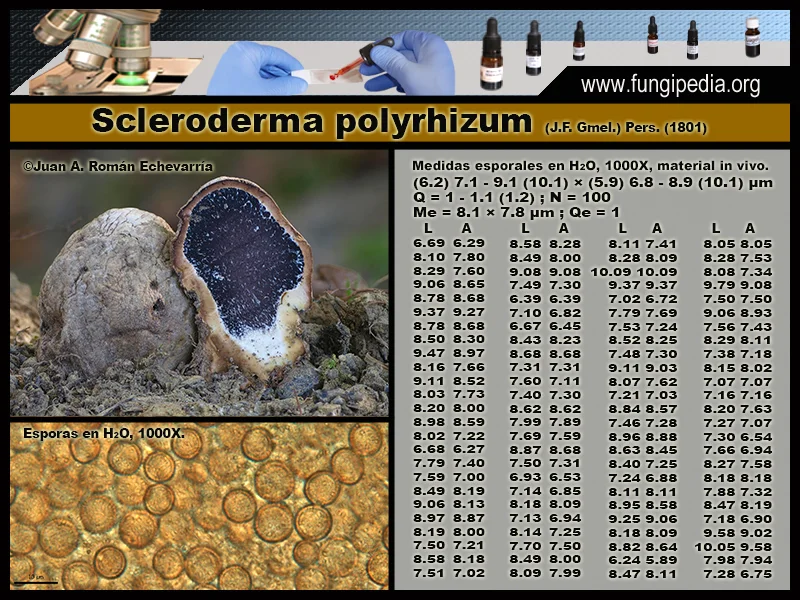
Basidiocarp with a more regular shape than is typical for this type of semi-hypogeous species; in many cases globose and at other times somewhat oblong, generally tapering towards the base, where it usually presents an appendage-like prolongation that serves as its attachment to the mycelium. Upon maturation, the basidiocarp splits open stellately, allowing the gleba to release spores, and forming several lobes. It is a species that can reach considerable dimensions; its diameter occasionally reaches 15 cm, more commonly between 6 and 12 cm. When young, it has a pale, creamy color, but as it emerges it becomes ochraceous and darkens; upon drying after completing its reproductive cycle, it lightens again, remaining desiccated for extended periods depending on atmospheric conditions.
Peridium rugose or smooth, not scaly, with a very hard and tough consistency, sometimes lacerate, ranging from pale to dark ochre in color, with the interior paler than the surface; very thick, typically exceeding 0.5 cm, and occasionally reaching 1 cm in thickness.
Gleba initially pale, nearly white in color, but rapidly acquiring dark brown or blackish tones with occasional whitish streaks; ultimately becoming a dark brown powdery mass that, upon the basidiocarp splitting open and aided by wind and rain, disperses completely, emptying its contents.
Flesh absent as such, consisting solely of the gleba itself; initially compact and eventually disappearing. It has a neutral taste when young, and its odor, initially mild, becomes somewhat unpleasant upon maturation.
Habitat:
This species exhibits a semi-hypogeous growth habit; when young, it is practically buried but quickly emerges to the surface to complete its reproductive cycle. It is a very common, abundant, and widespread species that typically fruits in groups rather than isolated individuals, colonizing uncultivated and nutrient-poor soils, often along roadsides, as well as forest clearings in both broadleaf and coniferous woods, and even under trees with low mycological productivity such as eucalyptus. Its preferred fruiting period is late summer through autumn, although occurrence in other seasons cannot be ruled out depending on latitude.
Observations:
The genus Scleroderma comprises a series of species with generally semi-hypogeous growth habits sharing certain similarities, yet they are not difficult to distinguish from one another. The species under consideration is characterized by its very thick peridium and extremely hard consistency. Scleroderma meridionale is perhaps the most similar due to its equally thick peridium, but it is readily distinguished by its more yellowish coloration and the presence of a pseudostipe, which can even be elongated when deeply buried. Scleroderma verrucosum possesses a thinner peridium and also features a pseudostipe. Another species with which it is frequently confused is the ubiquitous Scleroderma citrinum, which has a yellowish coloration and a more scaly or cracked surface, along with a much more unpleasant odor.
Microscopy of Scleroderma polyrhizum