
Scleroderma areolatum
Taxonomy
Main synonym
Common names
Escleroderma areolado.
Geographic references:
Interactive map with data from GBIF.
Morphological Features:
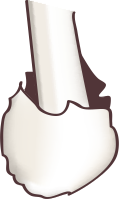
Carpophore of reduced size compared to what is typical for its genus; both in height and width, it ranges from 1 to 3 cm, up to 4 cm at most. It may be more or less globose, pear-shaped, or irregular due to lateral compression in the basal region. It exhibits an ochraceous coloration, occasionally with a yellowish tinge.
Peridium thin when compared to species with similar characteristics, which is one of its peculiarities. Externally, it is finely cracked into small ochre scales on a lighter or yellowish background; these scales are bordered by a typical areola that gives the species its name. Despite its rather coriaceous consistency, this peridium breaks with some ease; it is fragile, with whitish flesh, and tends to become practically smooth over time. Dehiscence occurs apically in a somewhat irregular manner. It is noteworthy to highlight the marked tendency of the external surface to redden upon rubbing or handling.
Stipe conspicuous in many specimens and appearing as a pseudostipe in others, provided with abundant mycelial hyphae at the base. It has a color similar to the rest of the carpophore.
Gleba compact and homogeneous, white in young specimens, darkening with age until nearly black, and becoming a powdery mass upon spore maturation. Its odor is typical of Scleroderma, but not as pronounced as in other species.
Habitat:
This epigeous species typically appears in numerous groups; contrary to what occurs with other related congeners that grow in nutrient-poor soils, this species prefers nutrient-rich substrates. Our collection was made under American oak (Quercus rubra), and the specimens stood out for their small size. It is not exclusive to a specific season; we have located it in early summer, but it may also fruit in autumn.
Observations:
This small Scleroderma is characterized by its thin peridium, its cracking into areolate scales, and its tendency to redden upon handling. Scleroderma verrucosum is certainly similar, but larger in size and with a much more defined stipe. Scleroderma citrinum is readily distinguished by its more yellowish tones and large size. Some species of the genus Rhizopogon, such as Rhizopogon roseolus, which also reddens, may also cause confusion, but a longitudinal section will resolve any doubts.