
Schizophyllum commune
Taxonomy
Main synonym
Common names
Esquizófilo común, ardagaitxo.
Geographic references:
Interactive map with data from GBIF.

Morphological Features:
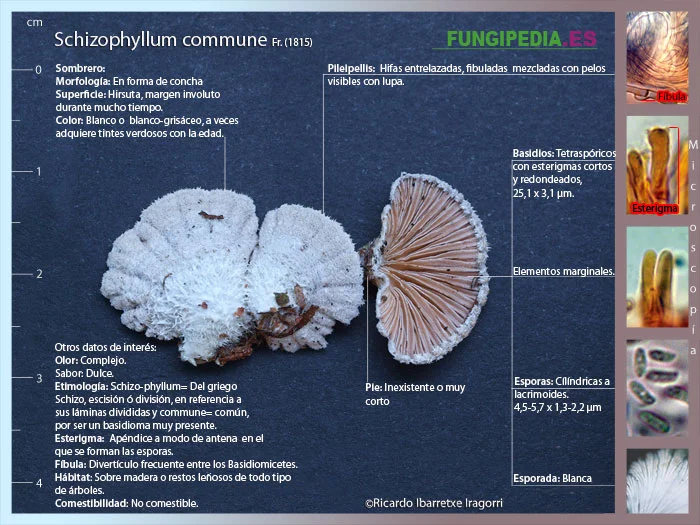
Basidiocarp of small dimensions, generally not exceeding 3 cm at its widest point, shell- or fan-shaped. It is typically caespitose or clustered, although it sometimes produces solitary basidiocarps. Surface villous, covered with erect hairs giving it a velvety texture, whitish-grey in color. Sometimes weakly zoned with ochre tones, and its margin remains involute for a considerable time, additionally being fimbriate.
Gills flesh-pink when young, darkening with age to nearly brown. They resemble folds more than true gills, and are arranged radially from the attachment point near the substrate. Their margins are doubly serrate, and they characteristically contract longitudinally upon drying.
Stipe absent or at most very short; it is typically attached laterally to the substrate.
Flesh elastic and coriaceous, ochre in color. Odor indistinct and taste mild.
Habitat:
As its name suggests, it is one of the most common and abundant fungi known. It fruits on wood or woody debris of all tree types, and is capable of doing so year-round.
Observations:
As a subsistence resource, it has even been sold in markets in some economically limited regions, particularly in Central America. In truth, it holds no culinary value, as its flesh, despite being sweet-tasting, is highly elastic and coriaceous. Due to its distinctive characteristics, we consider it an unmistakable fungus.
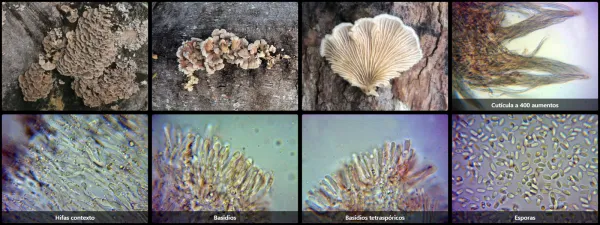
Microscopy of Schizophyllum commune