Sarcosphaera coronaria
Taxonomy
Main synonym
Common names
Peziza estrellada, Cassoleta blava, Koroa ubel.
Geographic references:
Interactive map with data from GBIF.




Morphological Features:
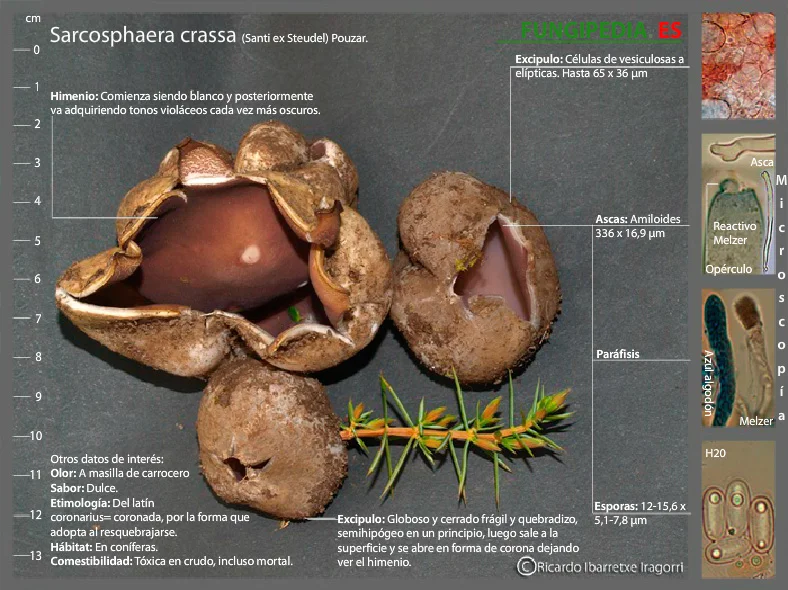
Fruiting body of considerable size, it can exceed 10 cm in diameter. It emerges from the ground as a hollow sphere, subsequently opening up to take a bowl-like shape, and finally unfolding definitively into a star shape or even flattening out. It is not unusual for it to assume irregular shapes when encountering soil resistance. The color of the external surface is dirty white.
Hymenium located on the internal surface of the fruiting body, completely smooth and violet in color, only fading or turning brownish with age.
Stipe absent; the fruiting bodies of this species are sessile.
Flesh quite thick compared to apothecia, with nothing remarkable regarding odor or taste.
Habitat:
It is a fairly common spring species in the pine forests of northern Iberia; however, it is not widely distributed geographically. It may also appear under spruce trees, but we have never observed it under deciduous broadleaf trees.
Observations:
Although it is known that many people have consumed it after cooking and subsequently discarding the water, we prefer to classify it as toxic, as it is highly poisonous when raw. There are no similar species, such as apothecia, that open into a star shape, so we consider this to be an unmistakable species.
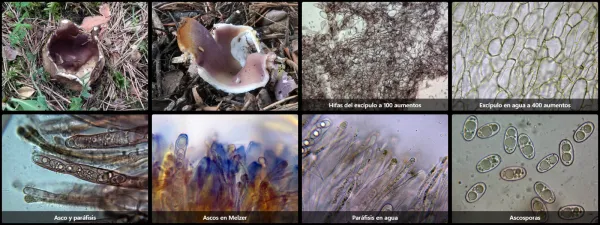
Microscopy of Sarcosphaera coronaria