
Rutstroemia firma
Taxonomy
Main synonym
Common names
Not available
Geographic references:
Interactive map with data from GBIF.
Morphological Features:
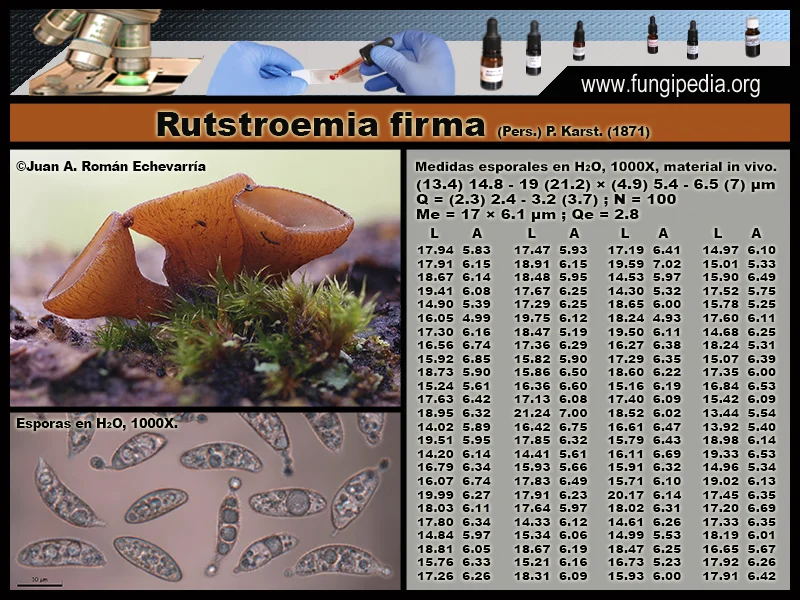
Fruiting body distinctly cup-shaped, composed of two perfectly differentiated parts: an upper portion resembling a cap or disc, and a stipe. The upper zone is cupuliform in young specimens, tending to open with development until it may flatten and become disc-like. It is small in size, generally with a diameter ranging from 0.5 to 1.5 cm; occasionally, we have found specimens reaching up to 2 cm. The external surface of the cup is smooth and glabrous (lacking hairs), occasionally only slightly furfuraceous near the margin. The margin is equally smooth and generally quite regular. The color of this external zone varies depending on the specimen's hydration, but always within dark ochre or brown tones, rarely with an olive tinge.
Hymenium occupying the entire internal surface of the cup or disc, smooth and glabrous like the external surface, with no clear differentiation in color and texture between both surfaces in this case. It produces fusiform spores, white in mass, amyloid asci, and branched paraphyses, features that can be observed in our "Microscopic Features" section.
Stipe clearly distinguishable, of highly variable length, even among specimens from the same collection, ranging from very short stipes of merely a couple of millimeters to those that can substantially exceed the diameter of the cup, especially on semi-buried branches. It is cylindrical and smooth, with a color similar to the rest of the apothecium, sometimes slightly darker, especially at the base, which is furfuraceous.
Flesh quite fragile and somewhat elastic, scant and lacking consistency, without a defined odor and completely tasteless.
Habitat:
In our region, it is a relatively frequent species, always fruiting directly on wood, never terrestrial, primarily on the wood of various broadleaf trees such as oak. We have also observed it on alder branches or other riparian trees, and it is quite cosmopolitan. It is a fairly gregarious species; where it occurs, a notable number of specimens usually appear, making isolated sightings very rare. This cold-tolerant species can be found in late autumn and even during winter in northern Iberia, as well as in spring in more southern areas.
Observations:
We are dealing with a species characterized by its cup shape, ochre or brown color, and lack of hairs on both the exciple and hymenium. It is very easy to confuse it macroscopically with other species of the genus Rutstroemia, as well as with other genera such as Ciboria, making an exhaustive analysis necessary for correct identification. Rutstroemia alni also fruits on alder wood and is very similar; its spores are wider, up to 9 µm. Rutstroemia echinophila differs by its peculiar habitat on chestnut burrs and old chestnut fruits. Species of Ciboria tend to be even smaller and are not strictly lignicolous like this species.
Microscopy of Rutstroemia firma