
Russula violeipes
Taxonomy
Main synonym
Common names
Rúsula de pie violeta, gibel hori-ubela.
Geographic references:
Interactive map with data from GBIF.
Morphological Features:
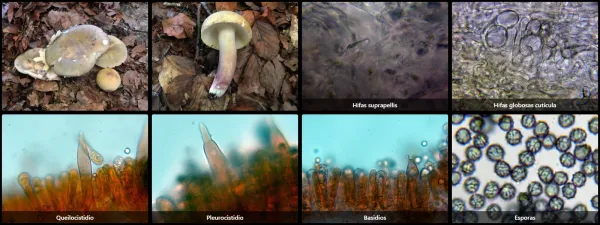
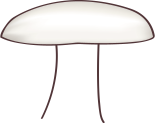
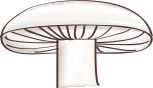
Pileus reaching up to approximately 10 cm in diameter at full maturity; initially subglobose, soon becoming convex and finally flattening out, while retaining a slightly depressed center. Initially dull yellow or yellowish-green, it shifts throughout its life cycle to distinctly greenish tones in the central zone and more violaceous hues toward the margin. The cuticle is dry, and the margin is smooth in young specimens, becoming weakly striate with age.
Lamellae adnate to subdecurrent, whitish in color, turning pale cream after sporulation; rather crowded and intervenose, with the edge concolorous.
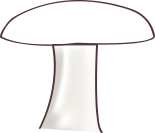
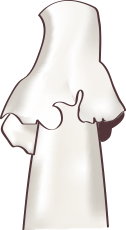
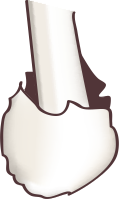
Stipe proportionate to the pileus or somewhat short. White in color, but gradually acquiring a violet tinge with age. Cylindrical and slightly attenuated at the base; solid when young, becoming cavernous with maturity.
Flesh thick and brittle, white in color, becoming more spongy in the stipe of older specimens. The taste is sweet but not particularly agreeable, and the odor resembles that of Russula amoena, though less pronounced.
Habitat:
This species shows no preference for a specific tree type, fruiting equally under conifers and broadleaf trees. The photographed specimens were found in summer beneath oaks, but it is more commonly encountered during autumn. It is an uncommon mushroom, rather rare.
Observations:
Listed as edible in some monographs due to its flesh lacking an acrid taste; however, it is not worth consuming owing to its poor flavor. Yellow specimens are classified in certain works as Russula violeipes f. citrina, although current taxonomic trends favor grouping them all within the taxon presented here. In this state, it may resemble other species such as Russula solaris or Russula acetolens, the former being viscid and striate, and the latter possessing a characteristic odor. The violaceous or greenish forms resemble other Russulas of the Russula amoena group, although the latter always has a violet stipe and a more pronounced odor.