Russula torulosa
Taxonomy
Main synonym
Common names
Gibelmore hankamore.
Geographic references:
Interactive map with data from GBIF.




Morphological Features:
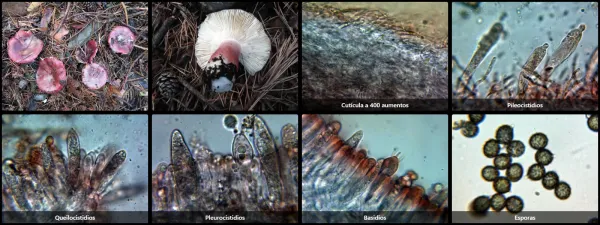
Pileus up to 10 cm in diameter in the largest specimens, fleshy in appearance, initially globose, becoming convex, finally plano-convex; a Russula that does not flatten completely, but typically develops a central zone that transitions from gibbous to depressed with age. The surface is dark violet or blackish at the center and purplish-red or violet towards the margin, which is paler. Cuticle barely separable and glossy during rainy weather.
Lamellae adnate and crowded, with interspersed lamellulae, white in color, becoming cream-colored at maturity.
Stipe proportionate to the pileus or slightly shorter, central and cylindrical, quite thick, entirely reddish-violet in color.
Flesh thick and firm; in young specimens it is very hard, to the point of being difficult to break. It is white in color, though it acquires violaceous tints beneath the pileal cuticle. Its taste is notably acrid and its odor is fruity.
Habitat:
A common species in our pine forests, where it grows with relative abundance, particularly during autumn.
Observations:
Its acrid taste and the hardness of its flesh render it inedible. Due to its habitat, it may be confused with Russula sanguinea, which displays red rather than purplish tones and yellowish lamellae with age. Based on pileal coloration, it can be mistaken for Russula atropurpurea, which however possesses a white stipe; nevertheless, the most closely similar species is Russula queletii, a montane taxon whose lamellae do not turn cream-colored.