
Russula solaris
Taxonomy
Main synonym
Common names
Not available
Geographic references:
Interactive map with data from GBIF.
Morphological Features:
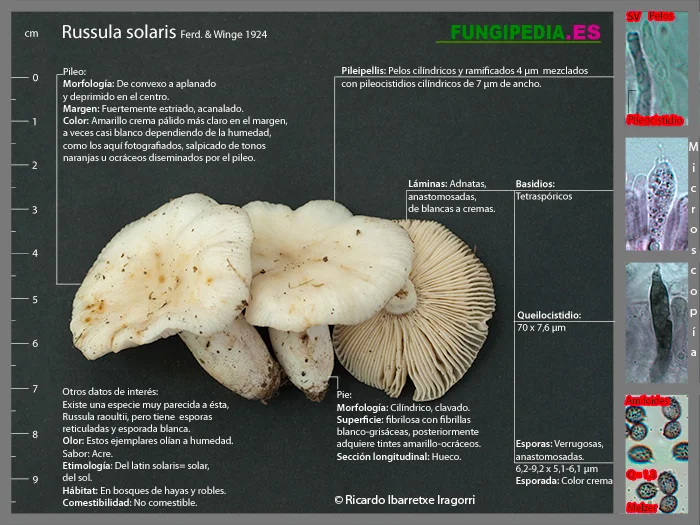
Pileus of medium size, may exceed 5 cm in diameter when fully developed, but never reaches 10 cm; initially rather globose, subsequently convex, and finally expanded, sometimes even exhibiting a slight central depression. Its color varies depending on climatic conditions, being egg-yellow in the center but fading towards the margin, sometimes becoming practically whitish. The cuticle may be slightly viscid when wet, shiny, and partially separable, which is also a variable character. The margin is distinctly striate.
Lamellae adnate, white when young, turning slightly ochreous-cream with age. Relatively crowded when young, and forked, sometimes even interconnected.
Stipe proportionate to the pileus in size and white in color, may become stained with ochre with age. Slightly pruinose, irregular in thickness along its length, with swellings.
Flesh thin, fragile, white, becoming spongy in the stipe with age and brittle in the pileus. The taste is strongly acrid and the odor very unpleasant, ranging from chlorinated to vinegar-like.
Habitat:
This is a very infrequent species in these regions, fruiting in beech and oak forests. It appears early, during summer, although it also occurs in autumn. It usually grows solitary or in small groups of a few specimens; it is not highly prolific.
Observations:
This is a rather little-known Russula characterized by its yellowish to whitish pileus, forked lamellae, and unpleasant odor and taste. The most similar species is Russula raoultii, which is somewhat more slender and has an apple-like odor. Russula violeipes, when yellow, also resembles it closely; however, a violet-staining stipe will resolve any doubts, in addition to the considerable variation in spore print color. There are other yellow Russula species, but they possess a more ochreous or yellowish spore print.
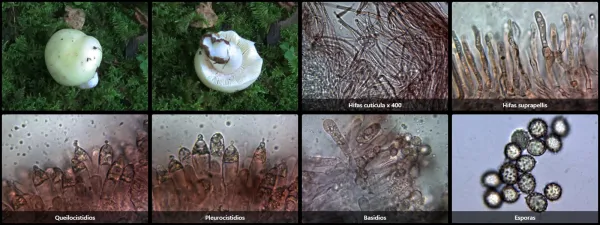
Microscopy of Russula solaris