
Russula sardonia
Taxonomy
Main synonym
Common names
Rusula acre, pinudi gibelubel, curalbra morada, bolet de foc.
Geographic references:
Interactive map with data from GBIF.
Morphological Features:
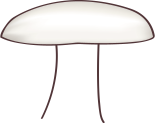
Pileus of medium size for the genus, with a somewhat fleshy appearance, and a diameter that generally ranges between 6 and 12 cm in mature specimens. It is notably convex when young, flattening with age to become slightly depressed in the center, but never infundibuliform. Cuticle smooth and not separable from the flesh except slightly at the margin, glossy when wet, otherwise subdry, highly variable in color as is typical for most species of the genus; in the typical form, violet or purple predominates, while a viridis form exhibits a uniform yellowish-green color.
Lamellae adnate to subfree, initially pale with a yellowish tinge, becoming conspicuously yellowish-cream at maturity; despite this, the spore print is not yellowish but dark cream. They are forked near the stipe. Margins entire and concolorous with the rest of the lamellae.
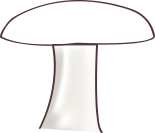
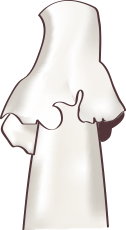
Stipe proportionate in length to the pileus diameter, generally cylindrical and central, solid and firm in young specimens, becoming somewhat spongy with age but never hollow. Surface slightly pruinose at the apex and otherwise smooth, white but tinged with violet or purple.
Flesh thick and firm yet brittle, white, occasionally developing yellowish tones when cut. Odor weak and faintly perceptible; taste, conversely, is intolerably acrid.
Habitat:
This species forms mycorrhizae with conifers, preferably pines. It is strictly acidophilous and rarely occurs in alkaline pine forests; within our study area, it is highly abundant under Pinus radiata, where it can carpet the ground during rainy autumns. It typically fruits in large groups, though occasionally found at other times of the year.
Observations:
In its typical form, this species is characterized by the violet or purple hues of the stipe and pileus, its conspicuously yellowish-cream lamellae, and the intense acridity of its flesh, which causes those who taste it to curse; due to this trait, it is inedible. Russula sanguinea appears at the same time and in the same habitats, equally acrid, but never exhibits purple tones, only reddish ones. Russula torulosa, more typical of calcareous pine forests, has a uniformly dark violet stipe, is also acrid, and possesses a more intense fruity odor. It can be easily distinguished from any edible Russula simply by tasting it, as the latter are sweet.