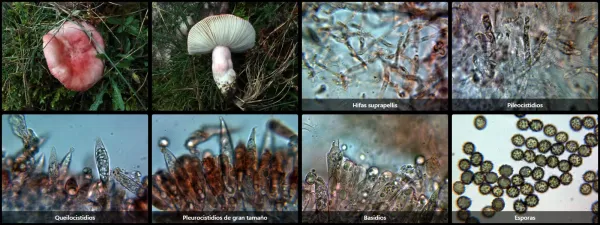
Russula sanguinea
Taxonomy
Main synonym
Common names
Rusula de sangre, pinudi-gibelgorri, cualgra sanguinea
Geographic references:
Interactive map with data from GBIF.




Morphological Features:
Pileus of good size and rather fleshy appearance, with a diameter that typically ranges between 5 and 10 cm in mature specimens. Initially convex in early developmental stages, it later becomes expanded and slightly depressed at the center; funnel-shaped specimens are very rare. The cuticle is smoothly rugose or undulate with little color variation, blood-red or quite saturated and uniform crimson-red, slightly to not at all separable from the flesh. It appears somewhat glossy when wet but is never viscid, rather dry and matte in most cases. The margin is incurved and regular in young specimens, not striate, becoming more expanded and undulate in older ones, occasionally showing a faint, subtle striation.
Lamellae subdecurrent, somewhat arcuate and rather crowded, especially in young specimens. Highly unequal in arrangement, they may fork or anastomose randomly. Coloration ranges from initial white to cream, eventually becoming ochraceous-cream, with a concolorous edge, though occasionally it may bear crimson blotches.
Stipe proportional in size to the pileus diameter, central and cylindrical, sometimes attenuated at the base, rugulose, white in ground color but splashed with crimson-red on its rugosities, a color that predominates in most specimens. Solid and frequently develops yellowish tones upon rubbing.
Flesh thick and firm, white in color, unchanging on exposure, though slightly tinged beneath the cuticle. It has a mild, insignificant odor, and an acrid taste, though not excessively intense.
Habitat:
This species forms mycorrhizae exclusively with conifers, particularly pines. We have located it under various pine species, sometimes fruiting in very numerous groups. It is therefore considered a very common and abundant species, appearing primarily during autumn, although it may also occur at other times of the year.
Observations:
This is a common species in our pine forests, characterized by its uniform reddish color with little variation, also on the stipe, its mild odor, and the tolerable acridity of its flesh. It typically appears at the same time and in the same locations as some Lactarius species of section dapetes, the well-known milk caps; we have even observed specimens of both species touching each other. It can be easily confused with several Russula species; due to its uniform red color, it might be mistaken for Russula nobilis, which is more typical of broadleaf forests and also has a white spore print and white stipe.