
Russula risigallina
Taxonomy
Main synonym
Common names
Not available
Geographic references:
Interactive map with data from GBIF.

Morphological Features:
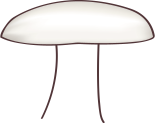
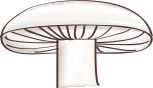
Pileus rather small for the genus; adult specimens rarely exceed 5 cm in diameter. Initially hemispherical in the early stages of development, becoming convex, then expanded, and finally slightly depressed at the center. The cuticle is separable from the pileal flesh and exhibits considerable color variation; the typical form is yellow, but specimens with orange, reddish, or even pinkish hues are found. Margin smooth in young specimens and striate in adults.
Lamellae adnate to subfree, cream-colored when young, later turning yellow with a strong orange tint. In adult specimens, they are relatively distant from each other, broad, and sometimes slightly serrulate.
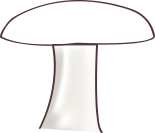
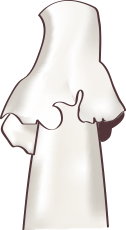
Stipe proportionate to the pileus or somewhat elongated, white, and cylindrical. Solid when young, becoming hollow with age; more fragile than is typical for species of its genus.
Flesh thin and scanty, with a fragile and brittle consistency, particularly in the stipe. Sweet-tasting; odor very distinct, aromatic, fruity at first, then becoming floral.
Habitat:
This species typically fruits in small groups during summer and also in autumn. Although occasionally reported under conifers, broadleaf forests constitute its most common habitat, which is where we have located it. It is frequent in some areas but very scarce in others.
Observations:
This Russula breaks the stereotype that all sweet-tasting Russulas are suitable for collection; the scanty and fragile nature of its flesh makes it unadvisable in this regard. It is characterized by its small size, a pileus with a separable cuticle exhibiting variable colors, an aromatic odor, and yellowish-orange lamellae. Several yellow-piled Russulas are prone to confusion; some, such as Russula raoultii, Russula fellea or Russula solaris, can be distinguished by spore print color—white in the first two and pale yellow in the last—whereas the species described here has a bright yellow spore print. Russula acetolens is very similar, but its vinegar-like odor gives it away. Russula helios also bears some resemblance, but its pileus is viscid.