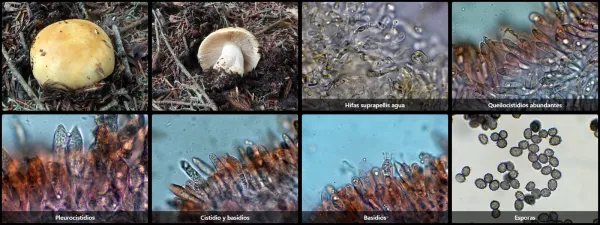
Russula ochroleuca
Taxonomy
Main synonym
Common names
Rusula ocre y blanca.
Geographic references:
Interactive map with data from GBIF.




Morphological Features:
Pileus up to 12 cm in diameter, uniformly ochre-yellow, more yellow when growing under conifers, convex to flattened, slightly depressed with age, with a somewhat grooved and undulate margin.
Lamellae white, adnate, rather thin.
Stipe white, proportional to the pileus, tending to become greyish. Slightly thickened at the base, which may also stain yellow.
Flesh whitish turning greyish, firm and rather thick, especially in the pileus; that of the stipe gradually loses consistency over time. The taste is slightly pungent and the odor is faint.
Habitat:
This species fruits during both rainy summers and autumn, often occurring widely under both broadleaf trees and conifers.
Observations:
The pungent taste of its flesh renders it inedible; however, it is a harmless species. It sometimes forms extensive carpets in pine forests alongside other Russula species, such as Russula caerulea or Russula sanguinaria. It is frequently confused with Russula aeruginea, which is more greenish and has an attenuated stipe base. It may also be mistaken for Russula fellea, which features a more brownish pileus center and an apple-like odor, as well as other yellow- to ochre-toned Russula species.