

Russula heterophylla
Taxonomy
Main synonym
Common names
Not available
Geographic references:
Interactive map with data from GBIF.




Morphological Features:
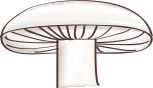
Pileus reaching 8 to 10 cm in diameter at full maturity, occasionally slightly larger; initially subglobose, gradually expanding to become completely flattened with a slight central depression resembling an umbilicus. Fundamentally green in color, although diffuse patches of various colors are common, particularly in the central zone where it is darker. The cuticle is partially separable and the margin is somewhat incurved.
Lamellae adnate, irregularly anastomosing near the stipe, white in color, fairly crowded, lacking a greasy feel, and relatively easily detachable.
Stipe cylindrical, sometimes attenuated at the base, white in color, occasionally bearing ochre stains, particularly in the lower portion. Proportional to the pileus size.
Flesh thick and firm, white in color, consistent but brittle, as characteristic of the genus Russula. Mild fungal odor and mild, pleasant taste.
Habitat:
Typically found during summer and autumn, preferably in broadleaf forests, but also under conifers.
Observations:
A good edible mushroom, though perhaps not reaching the culinary quality of other species in its genus, such as Russula virescens, with which it is often confused. The cuticle of this species is smooth, not cracked, and lacks the verdigris green coloration of virescens. It is also commonly confused with Russula cyanoxantha, which has greasy lamellae to the touch, a characteristic absent in the species described here.