
Russula chloroides
Taxonomy
Main synonym
Common names
Rusula de láminas verdosas, gibelzuri orribildu, pebrás.
Geographic references:
Interactive map with data from GBIF.
Morphological Features:
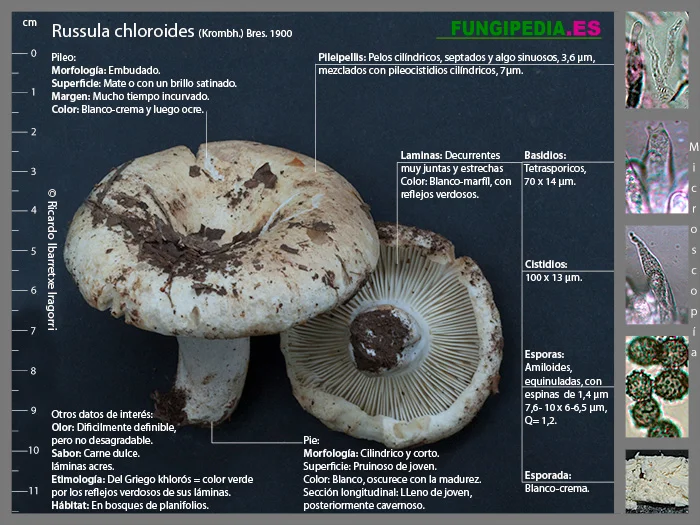
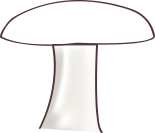
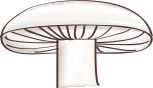
Pileus of considerable size, with a diameter ranging from 5 to 12 cm in mature specimens; convex and umbilicate when young, gradually flattening out and becoming distinctly infundibuliform with age. Its surface is whitish to cream-colored, developing ochraceous blotches in older specimens, smooth and finely felted, appearing extremely dry. The margin is involute for most of its development, becoming thin and regular only at maturity.
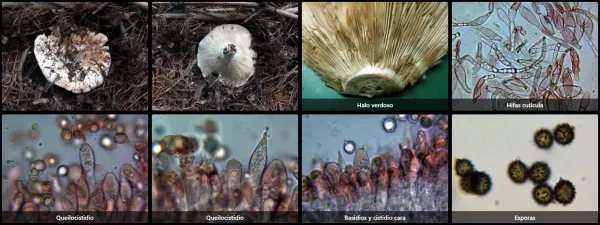
Lamellae generally slightly decurrent, fairly crowded, narrow, white but with greenish tints, particularly noticeable when the specimen is rotated.
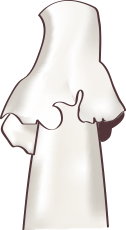
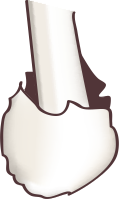
Stipe short and cylindrical, white, becoming slightly darker with age. Thick, sometimes slightly attenuated at the base, solid when young and cavernous when old, pruinose, occasionally exhibiting greenish-blue tints near the lamellae.
Flesh of gypseous consistency and white in color, quite thick. Sweet-tasting despite the acrid lamellae, with a distinct but hard-to-define odor that is not unpleasant.
Habitat:
This species is widely cosmopolitan, frequently found under beech trees, less common under other broadleaf species, and also observed in large numbers in coniferous forests such as those of Picea abies or Pseudotsuga menziesii. Fruiting bodies appear in more or less numerous groups, with autumn being the preferred season, although it may fruit at other times of the year.
Observations:
This is a Russula characterized by its sweet flesh contrasting with acrid lamellae, its whitish coloration, and the greenish tints it exhibits, particularly on the lamellae themselves. Russula delica, more typical of pine forests, is similar, but attains a larger size and lacks greenish tints. It may also be confused with Lactarius vellereus, especially when the latter is dry and exudes little latex.
Microscopy of Russula chloroides