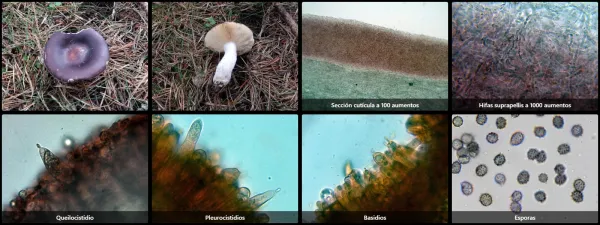

Russula caerulea
Taxonomy
Main synonym
Common names
Rusula amarga, gibelubel puntaduna.
Geographic references:
Interactive map with data from GBIF.


Morphological Features:
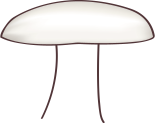
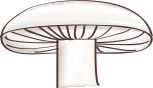
Pileus with an adult diameter ranging from 5 to 10 cm, initially conical, becoming bell-shaped, then convex, and finally plane, while maintaining a very prominent umbo at the center throughout all growth stages. The typical coloration of this species is purple, but it is a highly variable character, with forms ranging from brown to pink, and even whitish variants occurring. Cuticle smooth and separable, scarcely fibrillose, lustrous in damp conditions but not viscid; the margin may be striate, though not invariably so.
Lamellae adnate to subfree, rather crowded, white at first, then yellowish, and finally yellowish-ochre.
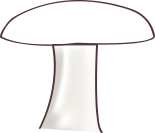
Stipe proportionate to the pileus, white and typically cylindrical. Solid when young, becoming cavernous with age, and slightly pruinose.
Flesh relatively thick and brittle, white in color, firm, becoming spongy in the stipe with age. Odor faintly fungoid; taste sweet in the pileus, though typically becoming markedly bitter in the cuticle and occasionally in the stipe, a trait that is somewhat inconsistent.
Habitat:
This is a species exclusive to coniferous forests, fruiting predominantly under pines. It may appear in summer, but is more frequent during autumn. It is a very common and abundant mushroom, occasionally forming true "carpets" in our pine woods.
Observations:
Despite belonging to the genus Russula and possessing sweet flesh, it is inedible due to the pronounced bitterness imparted primarily by the cuticle. While many basidiomycetes feature a prominent umbo at the center of the pileus, this trait is exceptional within the genus Russula, rendering the species readily identifiable to amateur mycologists. Bitterness is also atypical for the genus, as species usually exhibit an acrid taste or are simply sweet; this serves as another distinguishing trait that renders it virtually unmistakable.