
Russula amoenolens
Taxonomy
Main synonym
Common names
Rúsula de olor a amoena, gibelmarroi idaskatua.
Geographic references:
Interactive map with data from GBIF.


Morphological Features:
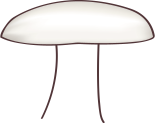
Pileus of medium size, frequently exceeding 5 cm in diameter without reaching 10, initially more or less subglobose, evolving to convex, then flattened, and finally depressed. Surface slick when moist, with a slight sheen, and occasionally viscid, becoming more matte in dry weather. Dark ochre in the center, lightening considerably toward the margin. This margin is markedly striate and involute in young specimens.
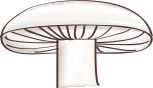
Lamellae subfree, whitish in color, becoming cream at maturity, fairly crowded and readily separable.
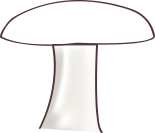
Stipe cylindrical, white in color, proportionate to the pileus or short. When young, it is solid, but becomes hollow with age. Older specimens exhibit a base stained with dull brownish tones.
Flesh thick and brittle, quite firm, white and invariable. Its acrid taste intensifies upon chewing until the burning sensation becomes unbearable, and its odor, described by some authors as resembling cooked crustaceans, we prefer to characterize as similar to that of Russula amoena.
Habitat:
We have observed this fungus throughout the year except in winter, generally fruiting in rows or clusters, rarely solitary. Within our area of study, it is a very frequent and abundant species, though not widely distributed geographically. We have always found it in oak forests, leading us to conclude that it is exclusive to broadleaf woodlands.
Observations:
This fungus is absolutely inedible due to its extreme acridity and poor taste. It can be distinguished with relative ease by its odor, as other species with a similar smell, such as Russula amoena or Russula amoenicolor, differ markedly in appearance and coloration. However, based on its shape and colors, it may be confused with several similar species; for instance, Russula sororia, which is larger in stature and does not react to guaiacum reagent as this one does. The Russula pectinata and the Rusula pectinatoides are also very similar, though they exhibit lighter tones.