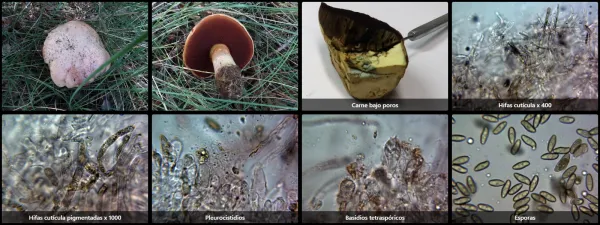
Rubroboletus lupinus
Taxonomy
Main synonym
Common names
Not available
Geographic references:
Interactive map with data from GBIF.




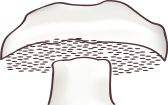
Morphological Features:
Pileus in the adult stage approximately 10 cm in diameter, hemispherical when young, subsequently convex, not becoming flattened except at the center. Color is variable, though generally a pale pink predominates, sometimes with hints of other colors. The cuticle is smooth, only weakly pubescent when young. The margin is irregular and tends to become yellowish in older specimens.
Tubes adnate, yellowish when young, becoming somewhat more olivaceous with age, short.
Pores round and small, ranging from orange to red in color, lighter toward the margin, bluing upon pressure with a finger.
Stipe typically cylindrical, though sometimes thicker in the middle region and slightly rooting. Entirely yellow in color, only occasionally suffused with pink, and completely lacking any reticulation or similar features.
Flesh thick and solid, yellowish in color with a soft consistency in the pileus, more compact and yellow in the stipe, except at the base where it acquires pinkish tones. Bruises blue when cut. Odor somewhat strong and taste acidic.
Habitat:
It can be found from late spring through autumn, almost always associated with deciduous forests. A relatively uncommon species.
Observations:
This mushroom is suspected to be toxic and therefore should not be consumed. Among red-pored boletes, it is distinguished from its congeners by its yellow stipe lacking reticulation and its pinkish tones. If the pore color is overlooked, it may be confused with Butyriboletus regius, which has yellow pores. In any case, it is to be hoped that all its congeners are as easily distinguishable as this one.