
Rickenella swartzii
Taxonomy
Main synonym
Common names
Not available
Geographic references:
Interactive map with data from GBIF.


Morphological Features:
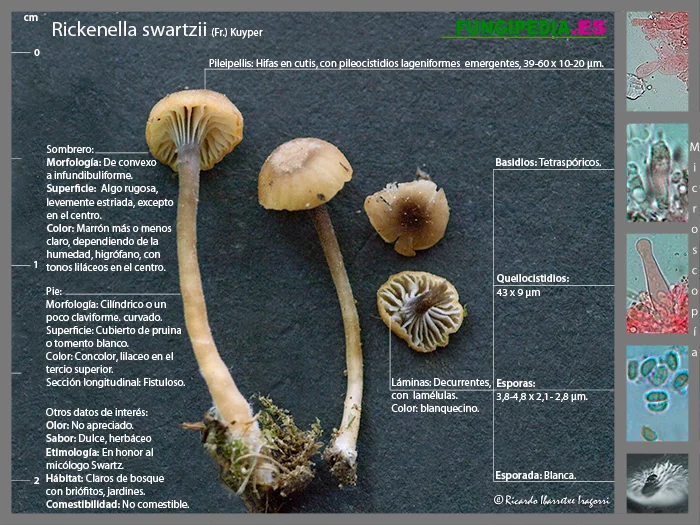
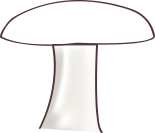
Pileus very small in size, rarely reaching 1 cm in diameter, convex in its early stages while maintaining an umbilicate center, rapidly expanding to adopt a more flattened shape. The central area is brownish, lightening considerably towards the margin, which is pale ochre. The margin appears striate, but this is due to its transparency; it is also thin and regular.
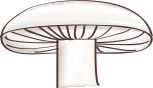
Lamellae distinctly decurrent on the stipe, fairly distant from one another, pale in color, dirty white or slightly yellowish when old, with some intercalated lamellulae.
Stipe disproportionately elongated relative to the pileus, fistulose in longitudinal section, finely pilose. It is dark at the apex, brownish, even with lilaceous tinges, becoming much lighter towards the base.
Flesh scanty, barely perceptible, brownish or pale ochre in color, with no distinctive odor detectable, and a mild taste.
Habitat:
This is a species we have consistently located on moss, regardless of the tree species involved—a factor we consider irrelevant in this case—as well as in gardens, and we have even observed it on moss growing on a concrete wall. The specimens studied were found in May, but its appearance is more frequent during autumn. A species much less common than Rickenella fibula.
Observations:
This is a small species that in most cases goes completely unnoticed among the moss, especially when its colors are dull, which is not the case with Rickenella fibula, which is more easily located due to its conspicuous coloration. It is a species hardly likely to be confused; at most, macroscopically it may resemble some Hygrocybe species, but these are never this small.
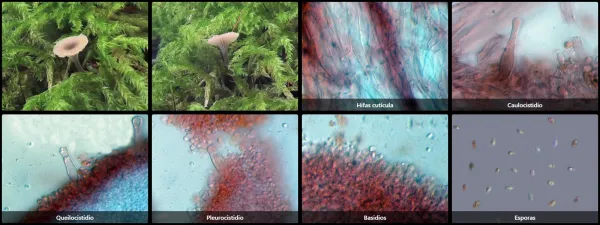
Microscopy of Rickenella swartzii