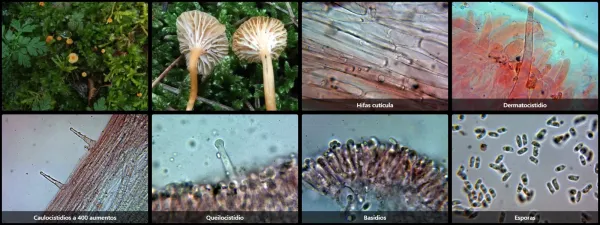

Rickenella fibula
Taxonomy
Main synonym
Common names
Onfalina alfiler.
Geographic references:
Interactive map with data from GBIF.


Morphological Features:
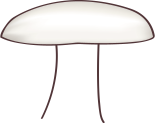
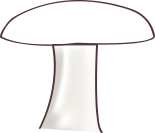
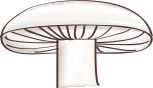
Pileus very small, rarely reaching 1 cm in diameter; it is normal to find them measuring 0.5 cm or even less. Bell-shaped in its early stage, later becoming plano-convex while maintaining an umbilicate center. The coloration is quite striking, and were it not for this, they would hardly be noticed due to their diminutive size. It is orange, particularly in the central zone, with a paler, yellowish margin. The edge is striate by transparency and typically exhibits grooves.
Lamellae can be considered thick relative to the diminutive size of the fruitbody, spaced apart from one another, and clearly decurrent on the stipe. They are whitish in color, although their wide spacing reveals the yellowish background of the flesh.
Stipe slender and very long, disproportionate relative to the pileus, cylindrical and pin-like in appearance. It shares the same coloration as the pileus.
Flesh barely perceptible, yellowish in color; both its odor and taste are also practically imperceptible.
Habitat:
It develops primarily during autumn, growing in gregarious clusters on various moss species, invariably in very humid areas. Quite frequent.
Observations:
This is a diminutive yet striking fruitbody, characterized by an umbilicate but not depressed center, and a disproportionately long stipe. These features macroscopically distinguish it from certain moss-dwelling species, such as Lichenomphalia umbilifera. Due to its coloration, it could also be confused with small Hygrocybe species; however, none of them attain such an extremely minute size. Mycena acicula, owing to its size and color, is also easily confused with this species.