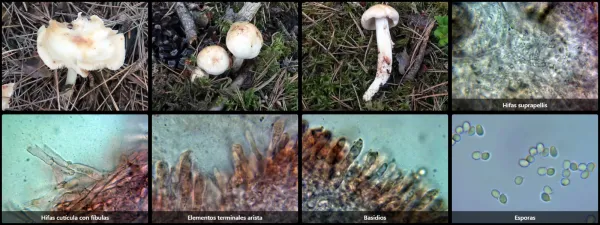

Rhodocollybia maculata
Taxonomy
Main synonym
Common names
Collibia manchada, kolibia herdoildu.
Geographic references:
Interactive map with data from GBIF.
Morphological Features:
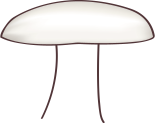
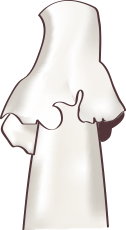
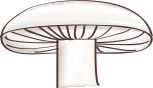
Pileus of good size, normally between 5 and 10 cm in diameter, occasionally slightly larger, convex evolving to plano-convex, but it is common to find somewhat deformed or compressed specimens. It is white when young, then slightly cream-colored, but it is spotted with rusty-brown discoloration in a somewhat random pattern. Its surface is smooth and glabrous, neither viscous nor even shiny, very matte. The margin is incurved when the mushroom is young.
Lamellae adnate, white in color, then cream, very crowded, with the edge slightly denticulate. It is frequent that they may also become stained with rusty-brown spots.
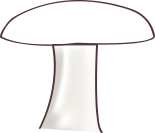
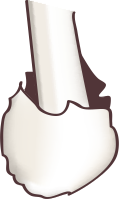
Stipe elongated, frequently exceeding the pileus diameter in length, of the same color as the latter, and similarly spotted with rusty-brown discoloration randomly. It is cylindrical except at the base where it becomes clavate and even radicate at the junction with the mycelium. It is solid and fibrillose.
Flesh fibrous and elastic in the stipe, thick and firm in the pileus, white in color. Its odor is mild and its taste is bitter.
Habitat:
A very frequent and abundant species that typically fruits in gregarious clusters in both coniferous and broadleaf forests. It fruits from late summer throughout autumn.
Observations:
Within its group, it can be distinguished by its whitish coloration, its prominent habit, and its characteristic rusty-brown spots distributed throughout the entire basidiocarp. It may be confused with Rhodocollybia prolixa var.distorta, which however lacks a white pileus, being instead tawny or reddish, and its stipe is typically twisted. The rare Gymnopus hariolorum is also white but smaller and has a very unpleasant odor.