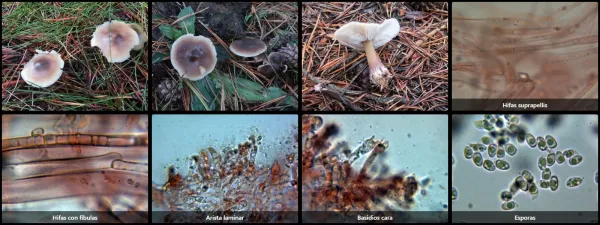

Rhodocollybia butyracea
Taxonomy
Main synonym
Common names
Collibia butirácea, Kolibia gurinkara.
Geographic references:
Interactive map with data from GBIF.
Morphological Features:
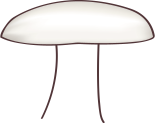
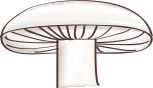
Pileus that can easily exceed 5 cm in diameter, convex when young, later flattened, but retaining an obtuse umbo at the center. Grayish-brown in color, with a darker center fading towards the margin; it fades completely under dry conditions due to its hygrophanous nature. Surface smooth, with a shiny and greasy appearance but not viscid.
Lamellae adnate to subfree, white in color, becoming slightly creamy at maturity, quite crowded.
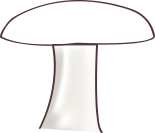
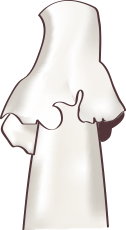
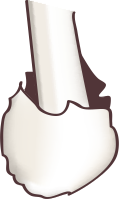
Stipe proportionate in size to the pileus and of a similar color, fibrillose, occasionally with a broadened base. Its shape is variable, sometimes straight and at other times sinuous or curved, fistulous when young, later hollow. Longitudinally grooved in some specimens.
Flesh scant relative to the size of the mushroom, white in color, absorbs much water becoming soft and insubstantial. Odor mild and fungoid; taste consistent with its odor.
Habitat:
It is undoubtedly one of the most common species found in our forests, and is moreover very abundant. It shows no preference for a specific forest type, occurring in oakwoods, beechwoods, pine forests, etc., with its fruiting period beginning in late summer and lasting throughout autumn.
Observations:
This mushroom lacks culinary value, though it is otherwise relatively easy to identify. Rhodocollybia butyracea var. asema, which possesses a lighter pileus, is now synonymized. Another related montane species is Collybia filamentosa, characterized by a reddish-brown pileus and serrulate lamellae.