Rhizopogon roseolus
Taxonomy
Main synonym
Common names
Criadilla rosada, sasiboilur arrosa, fetjo rosat.
Geographic references:
Interactive map with data from GBIF.





Morphological Features:
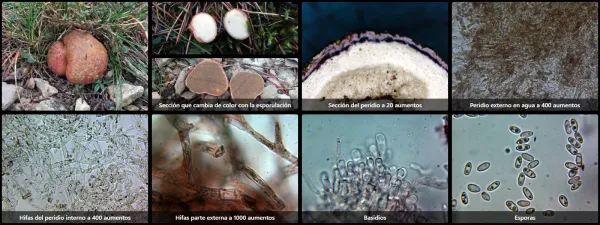
Fruiting body rather small in size, rarely exceeding 5 cm in diameter, typically found between 2 and 5 cm. It has a tuberculate shape, resembling a small potato or similar, sometimes spherical but usually irregular, with slight protrusions or confluent fissures towards the base. The color is variable; in early stages it is nearly whitish with a pinkish tinge, later turning reddish-brown, and sun-exposed specimens may even acquire a more olivaceous tone. The base exhibits evident rhizomorphs that characteristically adhere to the peridium itself.
Peridium extremely thin, reaching approximately only half a millimeter in thickness; furthermore, it is firmly attached to the gleba and inseparable from it. Externally displaying the aforementioned coloration, in cross-section it appears as a fine reddish or pinkish line bordering the gleba. It lacks apical dehiscence; older specimens may develop up to three fissures that reveal the gleba.
Stipe absent.
Gleba loculate, i.e., divided into small spaces or cavities, with a spongy appearance. When young, whitish to yellowish; later turning olivaceous-brown, with some fine veins, especially towards the base, which become deliquescent in older specimens.
Habitat:
A species considered to have hypogeous or semi-hypogeous growth; however, older specimens typically have most of the fruiting body exposed epigeously. Forms mycorrhizae with various conifers, showing a particular preference for pines. Generally appears in groups and may fruit in spring, although it emerges most abundantly in autumn. Quite common.
Observations:
The genus Rhizopogon comprises hypogeous or semi-hypogeous species that form mycorrhizae and are ecologically associated in a manner similar to certain Ascomycetes, such as truffles. These species typically possess a thin peridium and pentasporic basidia, sharing some microscopic characters with the order Boletales; consequently, there is a tendency to include them within this order, which can be somewhat confusing. Rhizopogon luteolus is yellowish in color, and its peridium does not redden when rubbed.