
Rhizopogon rocabrunae
Taxonomy
Main synonym
Common names
rizopogon escamoso
Geographic references:
Interactive map with data from GBIF.
Morphological Features:
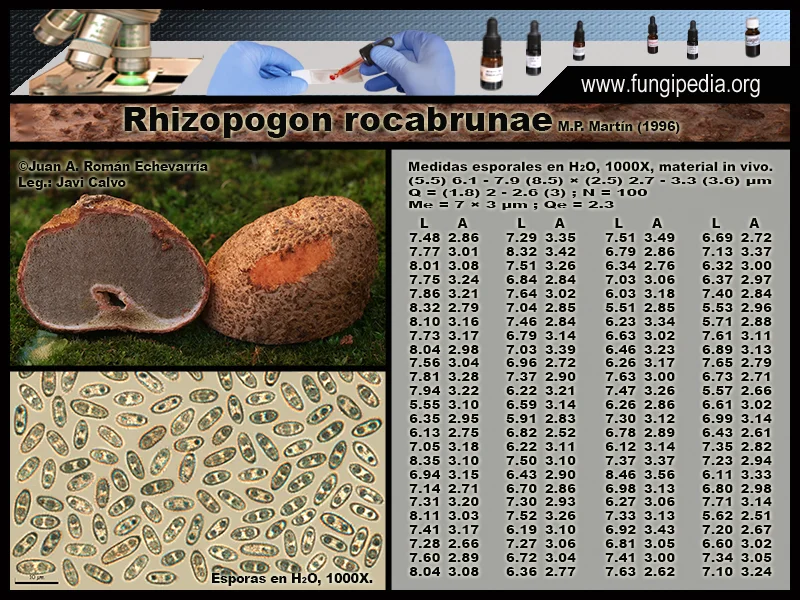
Basidiocarp measuring between 2 and 5 cm in length by 2–3 cm in height in our collection, indicating that some specimens were practically globose, whereas others were distinctly oblong, considerably longer than wide, always exhibiting the small potato-like appearance characteristic of this type of species. It is particularly notable for its beautiful, quite intense orange-ochre coloration in young specimens, which tends to fade with age; its warty surface, unusual for the genus Rhizopogon; and the fact that it stains a very striking reddish-orange when scratched with a fingernail or cut. The base bears mycelial cords, but in this species they do not extend around the basidiocarp as seen in other related species.
Peridium quite thin, measuring only 1 to 2 mm in thickness, differentiated into two layers: an outer layer or exoperidium of orange-ochre color formed by pigmented hyphae emerging perpendicularly, imparting a scaly or warty appearance; and a whitish endoperidium with parallel hyphae. Upon sectioning, the outer layer clearly turns orange while the inner layer remains whitish. It also changes color at injury sites to an intense orange almost immediately, subsequently turning deep red.
Gleba whitish during the initial developmental stage, but rapidly turning more greyish, then greenish-grey. This gleba occupies the entire interior fairly compactly, is spongy to the touch, and loculate, composed of small cavities that are initially very minute and barely visible to the naked eye, but expand somewhat with development; they are labyrinthine in structure. Notably, it remains intact even upon specimen necrosis, without disintegrating into powder as occurs in other genera.
Flesh essentially absent as such, consisting only of the gleba, with no noteworthy odor or taste.
Habitat:
This is a predominantly spring-fruiting species; all references we have found correspond to localizations in April and May, with practically all occurring in coniferous forests. It is a species that must be considered quite rare or infrequent; however, where it fruits, it does so in small groups of a few specimens, making isolated individuals rare. Its growth habit is semi-hypogeous, barely protruding slightly above the surface when young, but becoming more visibly exposed upon maturation. Our collection was made in May, in a grassy area along the edge of a track within a Pinus sylvestris forest, in the Valderejo Natural Park, Álava (Basque Country).
Observations:
There is a strong tendency among inexperienced individuals to associate this type of species with truffles, which is entirely incorrect, as we are dealing with a semi-hypogeous Basidiomycete, not an Ascomycete. It differs from other congeners by its external appearance bearing well-differentiated scales or warts, and by its truncate spores. It closely resembles Rhizopogon roseolus, with which it shares certain microscopic structures, and which also, like the species under consideration, changes color when rubbed or cut; however, the differences lie in the fact that Rhizopogon roseolus has a smooth peridium and its spores are not truncate. Rhizopogon luteolus, which also possesses a smooth peridium, is more yellowish and invariable upon cutting.
Microscopy of Rhizopogon rocabrunae