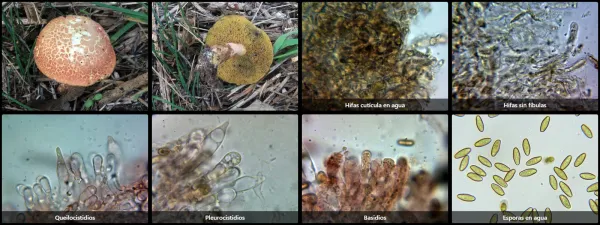

Rheubarbariboletus armeniacus
Taxonomy
Main synonym
Common names
Not available
Geographic references:
Interactive map with data from GBIF.
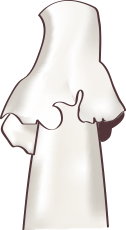
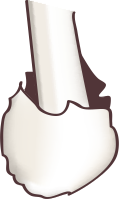
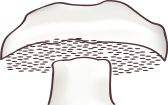
Morphological Features:
Pileus relatively small for the genus, typically not exceeding 10 cm in diameter, usually ranging between 5 and 7 cm. Initially hemispherical, later becoming convex, and nearly flat at maturity. The cuticle is pubescent when young, subsequently becoming smooth or felted, predominantly reddish with occasional ochraceous or pinkish tints. Margin irregularly undulate. Cracks during dry periods.
Tubes bright yellow, later turning olivaceous, adnate.
Pores yellow, relatively large, bluing weakly upon pressure.
Stipe cylindrical or fusiform in shape, pale yellow or whitish, and proportionate to the pileus. Occasionally weakly pustulate with reddish tones, though this is not typical. Base usually more or less rooting.
Flesh not particularly thick or firm, rather spongy, pale yellow, bluing weakly when cut. Pinkish beneath the cuticle and somewhat ochraceous at the stipe base. Odor and taste are faint and unremarkable.
Habitat:
Occurs in various forest types, growing gregariously or occasionally caespitose. Fruits primarily during autumn. Less common than other related species.
Observations:
This species is very closely related to Hortiboletus rubellus, with which it is frequently confused. Macroscopic differences are minimal; the pores are narrower and the cinnabar-red cuticle is more striking in Hortiboletus rubellus. The most definitive distinction lies in the cuticular structure and spore striations. It may also be confused with other species, such as Xerocomellus chrysenteron, which exhibits a reddish discoloration upon injury.