
Reticularia lycoperdon
Taxonomy
Main synonym
Common names
Hongo de luna.
Geographic references:
Interactive map with data from GBIF.



Morphological Features:
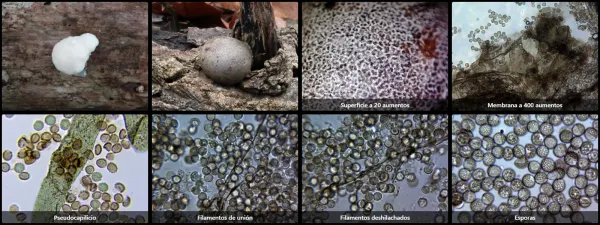
Plasmodium simple, more or less homogeneous and microscopic, exhibiting slow but irreversible plasmodial streaming, it feeds on small bacteria or microorganisms. Upon development, it forms distinct fruiting bodies called aethalia.
Aethalia large for the type of organism in question, they can reach up to 10 cm in length by 3 or 4 cm in width, protruding from the substrate by a couple of centimeters. When young, they are whitish, later becoming silvery, eventually cracking and turning brown. They are cushion-shaped, and their rather soft consistency helps distinguish them from fungi growing in the same habitat.
Stipe absent; it adheres directly to the substrate.
Flesh absent as such; internally, beneath the superficial layer, it contains a light brown mucilaginous mass. Upon maturation, it transforms into a powdery brown mass. When the outer layer ruptures, the spores are released in a manner similar to those of Lycoperdones; this distinguishing feature has given its name to the species in question.
Habitat:
This species is fairly common within our local area, though not abundant. It appears from spring through late autumn, fruiting on the wood of various trees, generally dead trees or stumps.
Observations:
It is one of the largest Myxomycetes forming distinct aethalia that we know of. It is common to find several individuals on the same trunk, but separated and never interconnected. It is difficult to confuse with other Myxomycetes; however, it can be macroscopically mistaken for the primordia of certain wood-inhabiting fungi, such as some Oligoporus, Trametes, or similar genera, from which it is distinguished by its softer consistency.