
Reddellomyces donkii
Taxonomy
Main synonym
Common names
Trufa de los eucaliptos.
Geographic references:
Interactive map with data from GBIF.

Morphological Features:
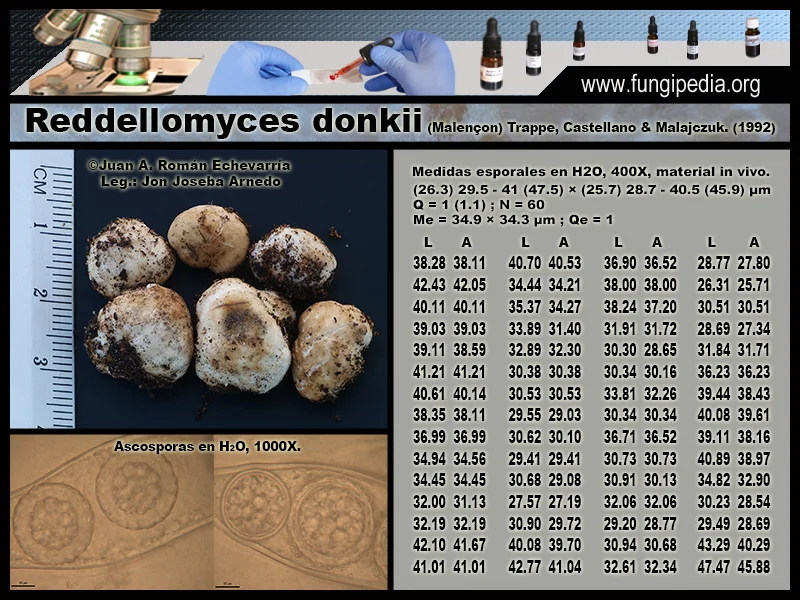
Fruitbody of notably small size, in many specimens little more than the size of a chickpea; the largest collected never exceeded 2 cm in diameter at most. Its potato-like appearance, as is common with hypogeous fungi, can be spherical, oblong, or assume more irregular shapes; however, it is not a species characterized by having numerous protuberances. When remaining buried or beginning to emerge to the surface, it is completely white, but as it matures it first turns cream-colored, and subsequently acquires a light ochre tone, sometimes with an occasional yellowish tinge. It has a smooth texture, even somewhat silky when young.
Peridium completely smooth and glabrous; despite its soft texture, it is entirely inseparable from the gleba. Originally white, it becomes cream or ochraceous with age. Furthermore, it is quite thin and dry in appearance, acquiring no viscosity whatsoever, not even after rainfall.
Gleba compact with an equally dry appearance; in younger specimens it appears as a solid white mass, lacking chambers or cavities. As the specimen matures, it retains its white sterile veins, while the remainder gradually acquires more ochraceous tones. Finally, the fertile zone cracks slightly and turns salmon-colored.
Flesh nonexistent beyond the gleba itself; compact. It lacks a distinctive odor unlike other hypogeous fungi; rather, its scent is mild, and its taste is slightly sweet, not unpleasant.
Habitat:
This is a non-native species, one of many introduced to the peninsula alongside the massive planting of various species of the genus Eucalyptus, with which it forms extensive mycorrhizae. Within this specific habitat, it is a fairly common and abundant species, although it often goes unnoticed due to its small size and hypogeous development, only partially emerging to the surface later on. In all collections we have made of this species, we have always found it in quite numerous groups; we have never observed it growing solitarily. We have several locality records for the species within the province of Bizkaia, in all cases under Eucalyptus globulus. It is a late-fruiting species, appearing from late autumn through spring.
Observations:
A species characterized by its small size, hypogeous or semi-hypogeous growth habit, initially white coloration turning cream or ochre, dry appearance, and exclusive occurrence under Eucalyptus ssp. As you will see in our microscopy section, it possesses thick-walled spherical spores, asymmetric asci with croziers, and a prosenchymatous peridium composed of quite compact hyphae. In the same habitat, Hysterangium inflatum is commonly found, with which it might initially be confused; however, a simple cross-section would easily resolve any doubt, given that this latter species possesses a characteristic greenish gleba, which is markedly different from the species described in this entry.
Microscopy of Reddellomyces donkii