Ramaria cedretorum
Taxonomy
Main synonym
Common names
ninguno
Geographic references:
Interactive map with data from GBIF.





Morphological Features:
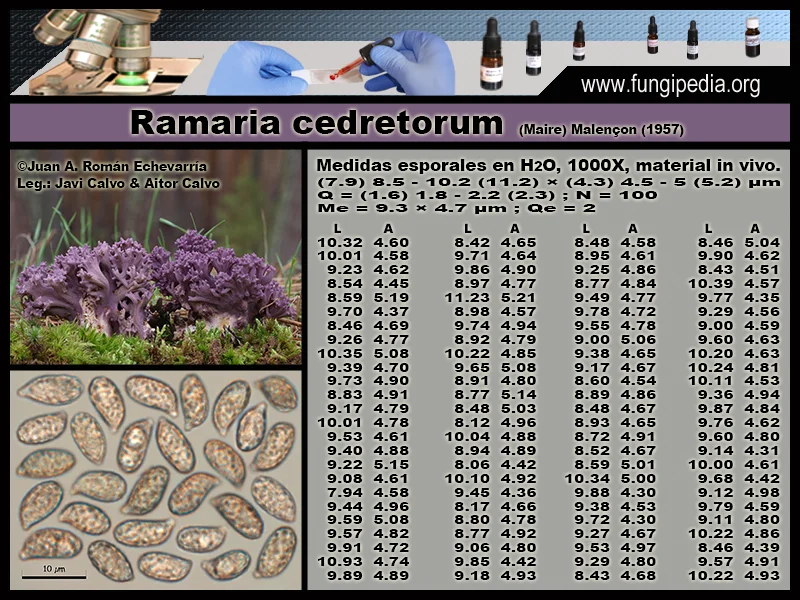
Basidiocarp of considerable size, it can easily exceed 10 cm in height, spreading to sometimes more than 15 cm in width. It has a branched form; from a central trunk arise several branches, which in turn divide into new branches, superficially grooved, ending at the apex in several crisped or blunt tips, particularly flattened in younger specimens. These young specimens exhibit a very beautiful and characteristic intense amethyst-lilac color, which over time and development fades to creamy tones, but retains some lilaceous hue for quite a while; older specimens become ocher-cream in color.
Hymenium smooth, covering the outer surface of the basidiocarp, lilac in color; only the basal region or stipe is sterile.
Stipe which is actually a basal thickening from which the branches arise, white in color and contrasting markedly with the lilac of the remainder, although on occasion it may be slightly tinged with lilac. It is solid and fleshy, thick, narrower at the mycelial attachment zone and thickening upwards, sometimes almost conical. At its thickest point, it can approach 5 cm in diameter.
Flesh white in color, also contrasting markedly with the surface; firm and hard in the basal region, appearing much more fragile and brittle in the branches. It lacks a noteworthy odor, and its taste is only slightly bitter.
Habitat:
Species located near the Pinarejos recreational area, Arauzo de Miel (Burgos), at an altitude of 1020 m, fruiting in clusters of numerous individuals under Pinus sylvestris. Despite the abundance in which they appeared, it is an infrequent or rare species that we have only been able to observe regularly at this specific location. It is a fundamentally autumnal species, recorded in November. Bibliographically, its habitat is described among mountain pines, as in this case, and also under cedars, with occasional collections reported under oak or in mixed forests.
Observations:
This is a Ramaria species characterized by the striking amethyst-lilac color of its branches, as well as its thick white stipe and only slightly bitter taste. There are other lilac-colored Ramaria species whose separation is complex and which are embedded within the fumigata complex; they were previously considered varieties of Ramaria fumigata, but have now been confirmed to be distinct taxa. The type species, Ramaria fumigata, is very similar, with a preferred habitat under broadleaf trees and subtle microscopic differences. Likewise, Ramaria fennica is more typical of beech forests and has a more faded coloration.
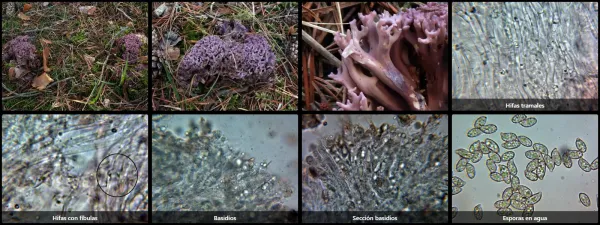
Microscopy of Ramaria cedretorum