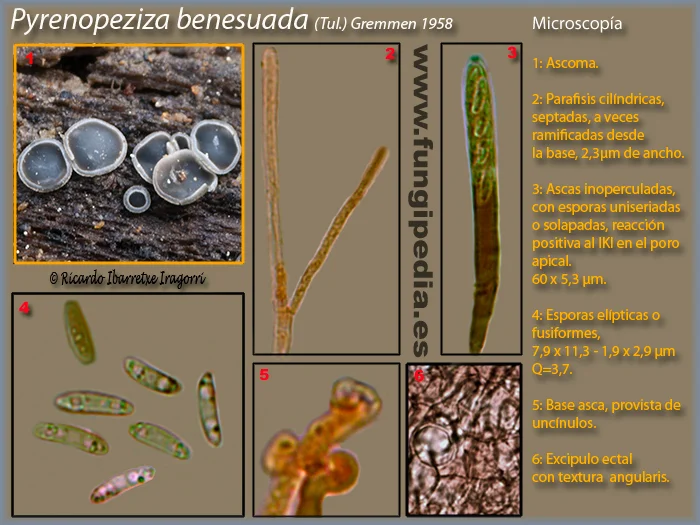

Pyrenopeziza benesuada
Taxonomy
Main synonym
Common names
Not available
Geographic references:
Interactive map with data from GBIF.



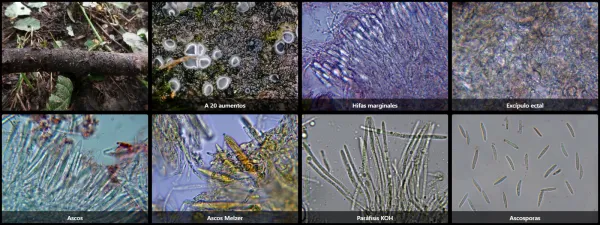
Morphological Features:
Fruiting bodies sessile, barely visible without a hand lens; the largest specimens barely exceed 1 mm in diameter. When young, discoid with a margin raised like a button; gradually this margin elevates, causing the ascocarp to assume a more compact or subhemispherical shape, while concurrently becoming irregularly undulate or lobed. The external surface is smooth and glabrous, pale watery gray in color.
Hymenium smooth, darker gray than the external surface, occasionally with a faint bluish tinge. It produces oblong-fusiform ascospores measuring 9–10 × 2–3 µm, along with filiform paraphyses.
Stipe absent; attaches directly to the substrate.
Flesh gray, with a cereaceous and unremarkable consistency, translucent in appearance; no distinctive odor or taste is discernible.
Habitat:
Collected during an exceptionally warm February on fallen alder branches (Alnus glutinosa), which corresponds precisely to its documented habitat. It fruits in gregarious or subfasciculate groups, typically on the underside of branches facing the soil, which further complicates detection, particularly given their minute dimensions. Moreover, it is a rare species, highly uncommon and scarcely documented in the literature.
Observations:
Pyrenopeziza is a relatively recently established genus encompassing species formerly assigned to the genus Mollisia. Studies on cultures of this species have revealed a novel antibiotic metabolite designated benesudone. Regarding comparative morphology, it bears a striking resemblance to Mollisia cinerea, which possesses cylindrical paraphyses that are septate near the base. Tapesia fusca also exhibits a similar appearance, but its most distinguishing feature is that it is borne on a stipe.
Microscopy of Pyrenopeziza benesuada