
Psilocybe semilanceata
Taxonomy
Main synonym
Common names
Bongui, sorgin zorrotz.
Geographic references:
Interactive map with data from GBIF.

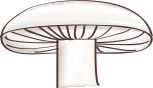
Morphological Features:
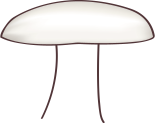
Pileus that in the best of cases may reach up to 2 cm in diameter, more commonly between 0.5 and 1.5 cm. It is conical for much of its development, later becoming campanulate, never fully expanding or flattening. Smooth cuticle with a greasy or viscid appearance when moist, otherwise subdry, variable in color due to hygrophanous properties, ranging from grayish tones with olivaceous tints to yellowish-ochraceous. A narrow and pronounced umbo stands out at the center, while the margin may be more or less striate depending on the degree of moisture.
Lamellae ascending and adnate, variable in color, cream when young and later olive-brown or purplish-brown, with a whitish sterile margin, moderately crowded. Spore print dark purplish-brown.
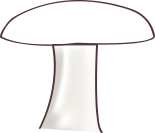
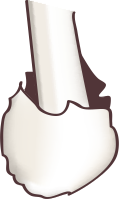
Stipe disproportionately elongated relative to the pileus diameter, easily exceeding 5 cm in length, smooth, often sinuous or otherwise straight, pale yellowish or sepia in color, may develop olivaceous tones due to oxidation.
Flesh scant and insubstantial, pale in color, with a somewhat radish-like odor and a slightly bitter taste.
Habitat:
This is a species that fruits on nitrogen-rich soils, in pastures frequented by livestock, or directly on dung, generally growing in gregarious clusters. It is relatively common in pastures above a certain elevation, but not so in coastal areas. It appears from summer onwards, with autumn being the most favorable season for its location.
Observations:
It is a highly sought-after species, commonly known as "bongui", despite its low toxicity, due to the presence of psychotropic compounds such as psilocybin. At moderate or low doses, this substance produces effects ranging from giddiness, hallucinations, alterations in space-time perception, etc.; however, excessive doses may cause adverse side effects, particularly when consumed after a heavy meal. We have observed that this species is frequently confused with other habitat-sharing taxa, such as Protostropharia semiglobata or various Panaeolus species, which also contain these compounds but are significantly more toxic than the species described here.