Deconica coprophila
Taxonomy
Main synonym
Common names
Not available
Geographic references:
Interactive map with data from GBIF.




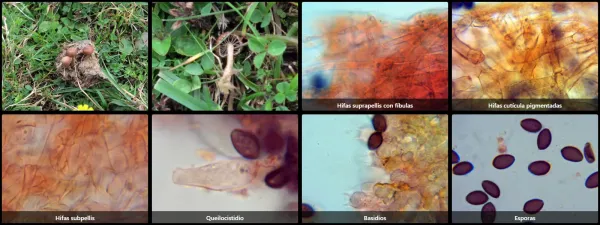
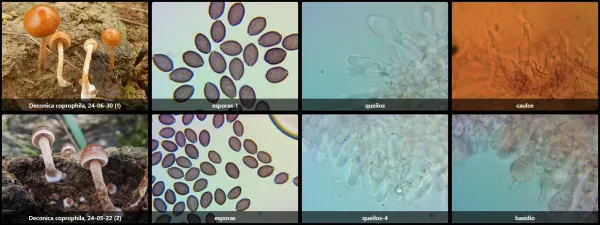
Morphological Features:
Pileus very small and highly uniform in shape, reaching at most 2 to 3 cm in diameter, and maintaining a hemispherical form from emergence to full expansion. Its color varies depending on the specimen's hydration; it is typically reddish-brown or tawny, but fades to lighter shades upon drying. Surface markedly viscid, especially after rain. Margin slightly striate in hydrated specimens due to its hygrophanous nature.
Lamellae adnate and well-spaced, ranging in color from grayish to dark brownish-black as the spores mature, generally retaining a whitish edge.
Stipe central and cylindrical, not exceeding 5 cm in length, occasionally curved at the base where it attaches to the substrate. Ocher in color, sometimes with brownish or yellowish tints. Completely lacking an annulus.
Flesh thin and indistinct, whitish in color, with a farinaceous odor and a somewhat peculiar taste, ranging between herbaceous and farinaceous.
Habitat:
As expected for a coprophilous species (as its name implies), we have located it on horse and sheep dung. It fruits primarily in late summer and throughout autumn. It is a frequent species.
Observations:
This is a species containing psilocybin, a compound with hallucinogenic effects in humans. In adults, it typically does not cause serious adverse effects, but accidental ingestion by a child could prove fatal. It closely resembles Psilocybe merdaria, which exhibits more olivaceous tones, as well as Psilocybe liniformans, which possesses larger spores.