
Pseudoclitopilus rhodoleucus
Taxonomy
Main synonym
Common names
Not available
Geographic references:
Interactive map with data from GBIF.


Morphological Features:
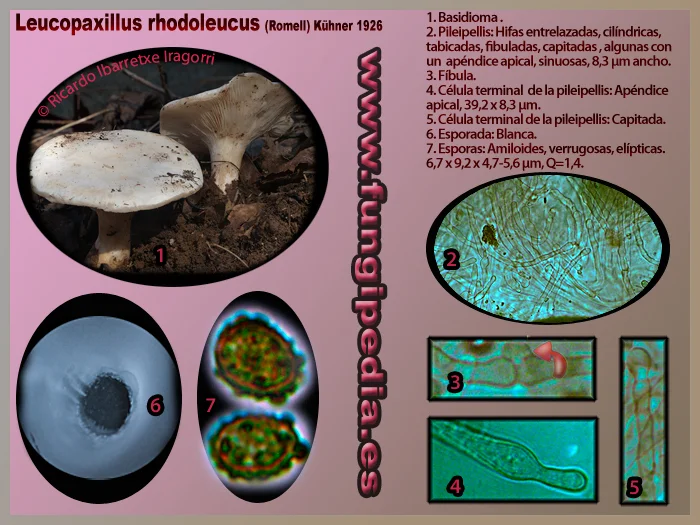
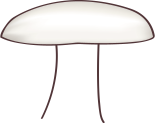
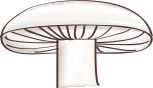
Pileus of medium size; the collected adult specimens had a diameter ranging from 3 to 7 cm. It is convex in younger individuals but soon becomes flattened and only slightly depressed at the center by the end of its life cycle, rarely becoming infundibuliform. It exhibits a satiny or glossy white color with creamier zones that often form macules on the surface. This surface may be somewhat felted in youth, later becoming pruinose and smooth, with a shiny appearance, especially when wet. The margin is thin and fairly regular, not striate.
Lamellae decurrent to varying degrees; in some specimens they are notably decurrent and close-set. The color variation of this hymenial zone is a relevant feature for macroscopic identification: when young, they are quite vividly pink, but with spore maturation they gradually turn white while retaining a faint pinkish tinge. This occurs because the spore print is white, not pink.
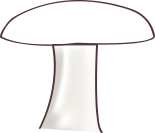
Stipe proportional to the pileus size and white like it, cylindrical, perhaps slightly attenuated towards the base, where it usually exhibits a cottony zone.
Flesh of normal thickness, tender but not fragile, white, unchanging. It has a strong, somewhat soapy and unpleasant odor, with an analogous, disagreeable taste.
Habitat:
An habitat in open areas, moorlands, and grasslands is described for this species; however, the collected specimens, courtesy of our friend and collaborator Josu Mota, although found near a moorland, were located in the vicinity of some oaks. It is a very rare species that warrants protection precisely due to its rarity, fruiting in large groups both in spring and during autumn.
Observations:
A toxic species that causes fairly serious gastrointestinal disturbances with vomiting and diarrhea. Exercise great caution with this fungus, as it is easily confused with the choice edible Clitopilus prunulus, whose lamellae turn pink upon maturation, whereas in this species they are pink and turn white upon maturation; furthermore, the flesh of the "molinera" has a very farinaceous odor and is more fragile. The pileus closely resembles that of toxic white Clitocybe species such as Clitocybe phyllophila or Clitocybe rivulosa, but the latter lack pinkish tinges on their lamellae.
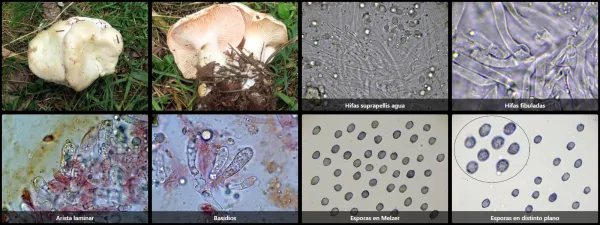
Microscopy of Pseudoclitopilus rhodoleucus