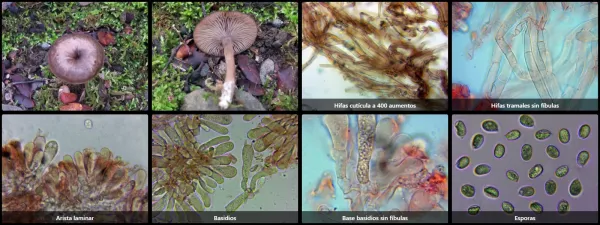
Pseudoclitocybe cyathiformis
Taxonomy
Main synonym
Common names
Clitocibe en forma de copa, tassa de bruc fosca, klitozibe beltz.
Geographic references:
Interactive map with data from GBIF.




Morphological Features:
Pileus may exceed 5 cm in diameter but does not reach 10 cm, funnel-shaped or cup-shaped, deeply depressed in the central zone. When adequately hydrated, it is dark brown, fading to ochre tones upon drying. The margin is thin and incurved, and may be slightly striate. The surface is smooth and hygrophanous.
Lamellae fairly crowded, whitish in color, occasionally with grayish tones; clearly decurrent on the stipe.
Stipe generally longer than the pileus diameter, central and usually curved. The background is whitish but adorned with darker fibrils, giving it a grayish appearance. It is solid and tomentose at the base.
Flesh scant, elastic in consistency, especially in the stipe, gray in color. It has a faint odor and an equally mild taste.
Habitat:
An eminently autumnal species that fruits equally under broadleaf trees and conifers, on grassy and moist soils, often in a gregarious manner. It is a frequent species in our forests.
Observations:
It lacks culinary value due to the elasticity of its flesh and the thinness of this species. It may be confused with Clitocybe brumalis, which however has a uniform grayish tone throughout the entire fruitbody. Its microscopic characteristics, for example the absence of clamp connections in its hyphae, have led to its separation from the genus Clitocybe.