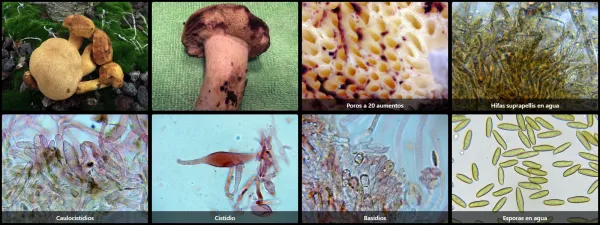
Pseudoboletus parasiticus
Taxonomy
Main synonym
Common names
Boleto parasitario, astaputz-onddo.
Geographic references:
Interactive map with data from GBIF.




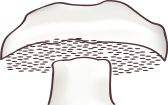
Morphological Features:
Pileus of small size, rarely exceeding 5 cm in diameter; emerges convex, gradually flattening but usually not becoming completely plane. Yellowish-ochre in color, more or less light depending on its degree of hydration; the surface is tomentose when young, eventually becoming smooth and glabrous. Margin quite regular.
Tubes adnate to slightly decurrent, yellow in color turning olive-green with age; rather short.
Pores large and angular, yellow in color, becoming olive-green when old with blotchy staining.
Stipe long, slender, narrow, and generally curved. Sometimes slightly broadened at the base to anchor into the junction with the parasitized Scleroderma. Yellowish background color, but covered with ochre fibrils that give it a darker appearance.
Flesh yellowish in color except beneath the cuticle, where it is more whitish. Thick relative to the small size of the mushroom, and also quite firm. Remains unchanged on cutting; odor mild and pleasant, taste similarly mild.
Habitat:
This species develops in summer and autumn, always appearing parasitizing various Sclerodermas, very especially Scleroderma citrinum, also referred to as vulgare. It should be considered a rare species, very infrequent.
Observations:
Boletus species are generally symbiotic in their lifestyle, forming mycorrhizae with the roots of various trees. It is therefore unusual to find a Boletus that behaves as a parasite, and this exceptional trait makes it a species easily recognizable by enthusiasts. For this reason, we consider it cannot be confused with any other species.