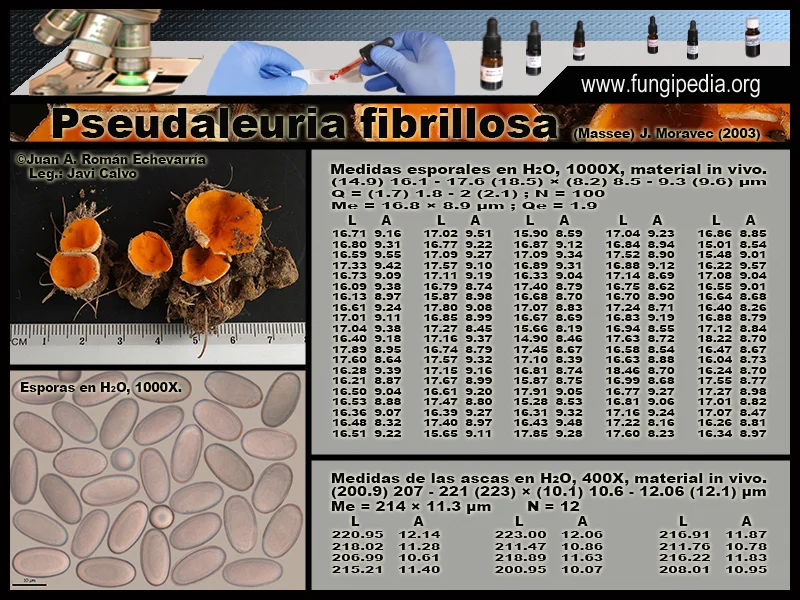

Pseudaleuria fibrillosa
Taxonomy
Main synonym
Common names
Not available
Geographic references:
Interactive map with data from GBIF.



Morphological Features:
Carpophore sessile, in the early stages of development with a rather convex shape, later tending to adopt a more discoid form without becoming completely flattened. It is a species of modest size; at most, its diameter may reach 3 cm. Its external surface or exciple is orange, though somewhat muted in intensity by the presence of small whitish hairs, and it appears tomentose to the naked eye. The margin is very regular in young specimens, becoming somewhat undulate at maturity, but not excessively so, and may also bear small hairs.
Hymenium completely smooth and glabrous, lacking the tomentose appearance of the exciple, which imparts a rather vivid orange color that hardly fades at maturity. It is common for the base to appear somewhat raised due to its adaptation to the substrate on which it grows.
Stipe completely absent as such; this is a sessile species that rests directly on the ground where its apothecia develop.
Flesh thin and quite fragile, orange in color like the rest of the carpophore; it is tasteless and lacks any distinctive odor worthy of mention.
Habitat:
This is a species we have located in several different places. The specimens used to compile this record were found in the locality of Ubide, Bizkaia, on unvegetated soil within a mixed forest near Lawson cypresses (Chamaecyparis lawsoniana), as well as in Abornicano, Álava, near Picea abies. It is a gregarious species, always observed in small groups, and is predominantly autumnal. Although we have encountered it near conifers, it has been documented in other habitats such as holm oak or cork oak woodlands. We believe it is not particularly rare in our region; rather, it often goes unnoticed due to confusion with more common species such as Aleuria aurantia.
Observations:
Species characterized by its vivid orange color, tomentose exciple with whitish hairs, and gregarious growth habit. Very similar at first glance to Aleuria aurantia, a species that can attain larger sizes and flatter forms, but easily distinguished microscopically due to completely different spores. Melastiza chateri also resembles it, but its hairs are more prominent and black; its microscopic features also differ. Neither species possesses smooth spores. The most similar species is Pseudaleuria quinaultiana, an American species with somewhat larger spores and more pointed hairs. The species under consideration has been classified within various genera, ranging from Tricharina to Cheilymenia.
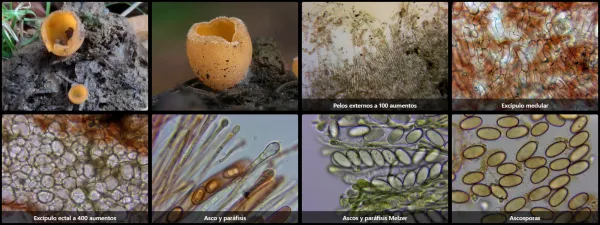
Microscopy of Pseudaleuria fibrillosa