
Psathyrella spadiceogrisea
Taxonomy
Main synonym
Common names
Not available
Geographic references:
Interactive map with data from GBIF.

Morphological Features:
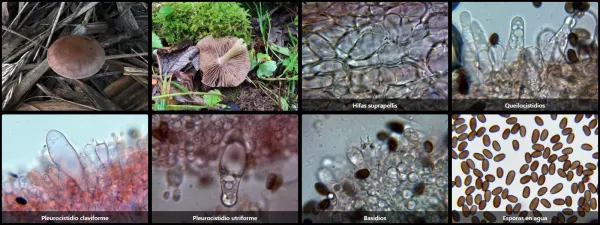
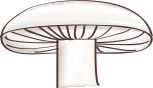
Pileus reaching up to 5 cm in diameter at full development, bell-shaped in young specimens, eventually becoming plano-convex while always retaining a somewhat inconspicuous umbo. Ochreous when well-hydrated, turning grey upon drying; additionally hygrophanous. Cuticle fibrillose or weakly rugulose, with a thin, regular to undulate margin.
Lamellae adnate and quite crowded, pale in youth, later turning greyish, finally becoming purplish-brown. In some specimens, they may become slightly decurrent down the stipe.
Stipe elongated, its length may reach twice that of the pileus, whitish in color. The upper portion is typically striate while the remainder is smooth, sometimes exhibiting floccose patches at the base. Hollow from an early stage and very fragile.
Flesh scant and soft, highly hygroscopic, whitish in color. Odor barely perceptible; taste mild.
Habitat:
A common species during spring, somewhat less frequent in autumn, though it can also be found in this season. Generally grows on the ground, rarely on wood, in areas rich in humus or decaying woody debris, sometimes gregarious but never fasciculate.
Observations:
Macroscopically, this species lacks clear diagnostic features, which may lead to confusion with numerous congeners. Among the most similar taxa is Psathyrella phegophila, nearly identical but completely lacking an umbo; Psathyrella subnuda is also very similar, though it typically exhibits veil remnants on the cap margin.