Candolleomyces candolleanus
Taxonomy
Main synonym
Common names
Satirela blanca, drosofila zuriska.
Geographic references:
Interactive map with data from GBIF.




Morphological Features:
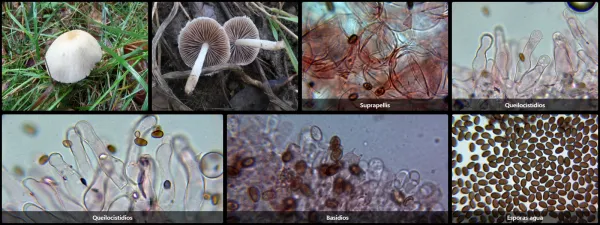
Pileus in mature specimens can reach up to 5 cm in diameter, occasionally slightly exceeding it; bell-shaped when young, gradually expanding to become nearly plane, weakly or not at all umbo-nate. Hygrophanous, hence its color varies from ochre to white depending on the hydration level; specimens are commonly found with an ochraceous center and a white remainder. Surface smooth; margin typically bearing whitish veil remnants that tend to disappear with age.
Lamellae sinuate, initially pale, then gray with a lilac tinge, finally brownish with purplish reflections. Quite crowded; the edge, being sterile, appears whitish.
Stipe cylindrical and elongate, slightly thickened at the base, white, fibrillose, and hollow even when young.
Flesh thin and soft-textured, very fragile, white. Odor faintly fungoid; taste sweet and similarly mild.
Habitat:
A highly abundant and widespread species that can fruit throughout the year under favorable conditions. Fruiting occurs in grassy areas and on woody debris from various tree species, without particular host preference, as well as in public parks and gardens, typically forming large clusters.
Observations:
Undoubtedly the most well-known and representative species of its genus. Although considered a mediocre edible by some authors, it is regarded here as lacking any culinary value. Psathyrella marcescibilis is macroscopically very similar, but can be readily distinguished microscopically as the only species lacking pleurocystidia and the hymeniform-type cuticle typical of the genus. Other smaller species with similar coloration exist, such as Psathyrella pygmaea.