
Protostropharia semiglobata
Taxonomy
Main synonym
Common names
Estrofaria semiglobosa, gorotz-sorgin txiki, bolet de fermer.
Geographic references:
Interactive map with data from GBIF.


Morphological Features:
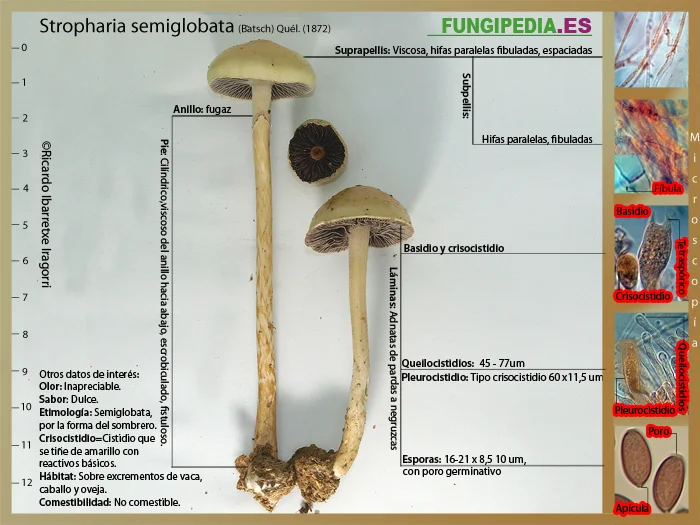
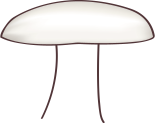
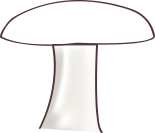
Pileus small, in most cases not exceeding 3 cm in diameter, uniformly hemispherical in shape, especially when young, becoming convex only in old or fully developed individuals. When the specimen is hydrated, its surface is viscid and yellowish, but otherwise it appears merely shiny with paler tones. Another notable feature is its smooth, non-striate margin, as it is not a hygrophanous mushroom.
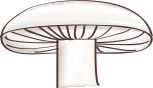
Lamellae adnate and rather thick, not too crowded, grayish when young, later turning olive-brown, and finally dark purplish-black.
Stipe long relative to the pileus, cylindrical, viscid in the lower two-thirds. Becomes hollow very early, even when young, and bears a very fugacious ring that tends to become dark and adherent when it does not disappear entirely.
Flesh thin and soft, whitish or pale yellow in color. Its odor is practically nil and its taste mild and sweet.
Habitat:
This is a very common species that fruits on cattle dung. It can be found throughout the year.
Observations:
It is suspected to contain toxic and even hallucinogenic substances; we classify it as having no culinary value due to this aspect still being poorly studied. It may be confused with Stropharia coronilla, which has a short stipe and grows on soil, with some Psilocybes that fruit on dung, such as Psilocybe merdaria, and with Stropharia umbonatescens, which features a sharp umbo at the center of the pileus.
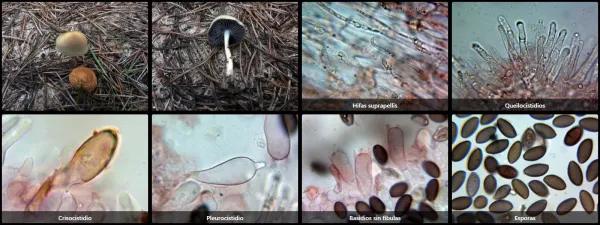
Microscopy of Protostropharia semiglobata