Amaropostia stiptica
Taxonomy
Main synonym
Common names
Not available
Geographic references:
Interactive map with data from GBIF.




Morphological Features:
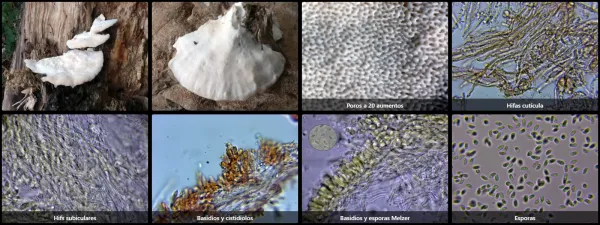
Basidiocarp of somewhat variable shapes, often forming a semicircle with solitary growth, and at other times forming true shelf-like structures with several individuals growing together and interconnected. Each individual can reach approximately 10 cm in width, with a projection of about 5 cm and a thickness of 2 to 3 cm at the point of attachment to the substrate. The pileal surface is pure white and remains unchanged upon rubbing or pressure, although it tends to become dirty and somewhat ochraceous with age. This surface is matte, finely velvety when young and smooth thereafter, and the margin is sharp in younger specimens, becoming somewhat more obtuse in older ones.
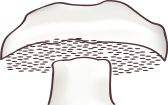
Hymenium composed of short white tubes terminating in round pores of the same color, measuring approximately 3 to 4 per mm. Like the pileal surface, they remain unchanged upon rubbing.
Flesh soft in consistency in young individuals, which is a distinguishing characteristic of this genus compared to other saprotrophic genera. Over time, this white flesh becomes corky, tending to turn slightly gray upon drying.
Habitat:
This is a sessile species that attaches to the woody substrate upon which it grows along a large portion of its total width. It fruits on dead wood of various conifers, being very rare under broadleaf trees; in this case, our specimens were found on wood of Pseudotsuga menziesii (Douglas fir). It is not a species that should be considered rare, and its fruiting period cannot be precisely defined since, under favorable conditions, it can appear practically year-round.
Observations:
The genus comprises a series of saprotrophic species that cause brown rot, with white sporocarps exhibiting reflections of other colors. The species presented here is characterized by its growth under conifers and a surface that remains unchanged under pressure. Tyromyces lacteus is very similar, but it is bitter and grows on broadleaf wood. Postia fragilis also resembles it closely, but its pileus stains brown rapidly upon the slightest rubbing.