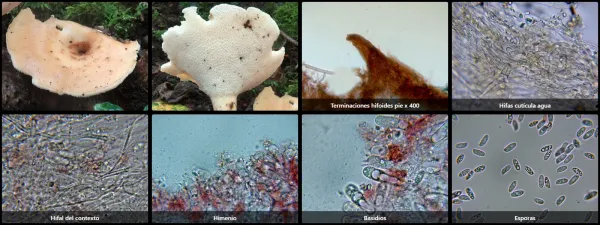
Polyporus tuberaster
Taxonomy
Main synonym
Common names
Poliporo de forquignon.
Geographic references:
Interactive map with data from GBIF.




Morphological Features:
Pileus may exceed 5 cm but rarely reaches 10 cm, variable in color from cream-ochre to browner shades, covered with scales darker than the background arranged radially. The typical form in which we encounter this species has a depressed pileus, although it occasionally appears expanded.
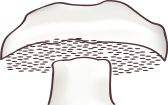
Tubes very short, white in color, decurrent on the stipe.
Pores whitish, polygonal, becoming broad and angular when the specimen is mature.
Stipe rather short, whitish in color turning ochre from the base upwards. Central and cylindrical but attenuated at the base, it sometimes exhibits a reticulate pattern near the apex formed by the pores decurrent onto it.
Flesh white in color, tender when young but becoming coriaceous with age, quite thick, with a mild odor and taste that are barely perceptible.
Habitat:
Grows on branches of deciduous trees in summer and autumn; we have located it on oaks and beeches. Although some authors state that it only fruits on branches in contact with the ground, our experience confirms that this is not necessarily the case.
Observations:
We do not recommend consumption due to the toughness of the flesh in mature specimens, although it is harmless. The reproductive biology of this species warrants further study; it apparently fruits occasionally via a hypogeous sclerotium. However, we have collected it on branches with no soil contact, rendering that pathway impossible; it likely employs two distinct reproductive strategies. It may be confused with other congeners such as Polyporus arcularius, which exhibits broad pores from an early developmental stage and occupies a different ecological niche.