
Polyporus brumalis
Taxonomy
Main synonym
Common names
Poliporo de invierno, neguko onddo-ardagai, bolet de soca.
Geographic references:
Interactive map with data from GBIF.

Morphological Features:
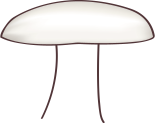
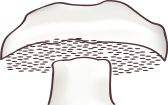
Pileus that in full development can exceed 5 cm in diameter, without reaching 10 cm; more or less convex or plano-convex when young, expanding at maturity, and often becoming depressed centrally. The margin remains incurved for an extended period and is somewhat undulate. Color varies from grayish-ochre to reddish-brown; the surface transitions from slightly tomentose to becoming scaly with age. Cuticle separable.
Hymenium consisting of tubes and more or less rounded to rhomboid pores, approximately 3 mm deep by 0.5–1 mm wide (2–3 per mm at most), whitish to cream-colored, turning yellowish with age. Typically decurrent on the stipe, widening considerably in this region.
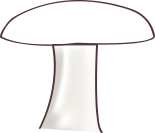
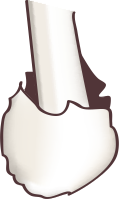
Stipe central, rarely eccentric, cylindrical, ochre-colored similar to the pileus or somewhat paler. Occasionally finely scaly, but more typically glabrous, solid, and hard.
Flesh hard and coriaceous, white, lacking a distinctive odor, with a slightly bitter taste.
Habitat:
A lignicolous species that fruits on fallen branches of broadleaf trees, occasionally on stumps. A fairly common species distinguished by its fruiting season, being primarily a winter fungus.
Observations:
This species is inedible due to the extreme toughness of its flesh. Its most reliable identification feature is its fruiting period, as fungal fruiting bodies are uncommon during winter months. Occasionally persisting into April, it may be confused with the spring-fruiting Polyporus lepideus=Polyporus ciliatus, which possesses much smaller pores that are imperceptible to the naked eye in young specimens. Another species with broader, more polygonal pores is Polyporus arcularius, which may also fruit in spring within the same habitat.