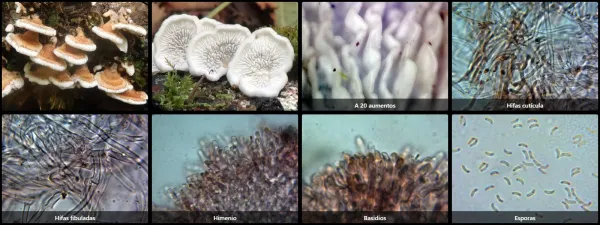
Plicaturopsis crispa
Taxonomy
Main synonym
Common names
Not available
Geographic references:
Interactive map with data from GBIF.





Morphological Features:
Basidiocarp with a width not exceeding 3 to 4 cm and a length between 1 and 2.5 cm. Typically fan-shaped, though specimens with less typical forms may be found, such as shell-shaped, or simply dimidiate fruiting bodies. Initially white at emergence, but this color is short-lived, quickly becoming ochraceous while the margin retains the original whitish hue for longer, acquiring tawny shades and sometimes yellowish tones when old. Surface somewhat zoned, initially tomentose then finely velutinate, with an undulate or even lobulate margin in some specimens.
Hymenium composed of folds resembling lamellae, irregularly arranged yet radial, and anastomosing. Color ranges from initially whitish to cream, becoming grayish later.
Stipe rarely evident; generally presents a pseudostipe attaching it to the substrate, with a color similar to the rest of the basidiocarp.
Flesh very thin, whitish in color; quite soft in young specimens but becoming coriaceous with age. Lacks a noteworthy odor or taste.
Habitat:
A species that fruits on the wood of various broadleaf trees, in this case located on beech wood (Fagus sylvatica). Generally grows in groups of numerous individuals, frequently even imbricate. Fairly abundant in some years and scarce in others; it should be considered a relatively common species. It may appear practically throughout the year.
Observations:
This species is characterized by its growth in groups on wood, its folded hymenium, and its white spore print. The latter feature distinguishes it from species of the genus Crepidotus, which have a brown spore print. Schizophyllum commune, which also has a white spore print, is much more pilose and grayish, lacking the ochre tones of this species.