

Pleurotus nebrodensis
Taxonomy
Main synonym
Common names
Seta de caña.
Geographic references:
Interactive map with data from GBIF.




Morphological Features:
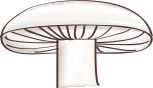
Pileus of good stature, its diameter at full maturity can reach up to 15 cm, developing in a very homogeneous and regular manner throughout its growth. Older specimens tend to become slightly funnel-shaped, but until then it maintains a plano-convex shape. It is white in color, especially when young, becoming somewhat cream-colored at maturity, but always matte. The cuticle remains dry even during rain, and the margin stays incurved for a long time, eventually becoming thin and regular.
Lamellae extremely decurrent on the stipe, as befits a true Pleurotus, rather crowded and interspersed with lamellulae, similar in color to the pileus.
Stipe generally shorter than the pileal diameter, especially in mature specimens, solid throughout all developmental stages, most often eccentric but rarely lateral. Towards the base it becomes radicate, particularly at the point of attachment to the roots of the host plant serving as its substrate. Concolorous.
Flesh thick and compact, firm, white in color, with a sweet and pleasant taste and a mild, faint odor.
Habitat:
It fruits throughout autumn, always associated with the roots of certain umbelliferous plants commonly known as cañas, belonging to the genus Laserpitium. This mushroom is highly localized and therefore must be considered rare, although in areas where it occurs, it reliably appears every year.
Observations:
This mushroom constitutes a highly prized edible, particularly when considering its substantial flesh and pleasant appearance, although it may not reach the culinary excellence of Pleurotus eryngii. It can be confused with the latter based on shape, but not by color or habitat. Furthermore, this species exhibits a larger size and more robust stature.