

Pleurotus dryinus
Taxonomy
Main synonym
Common names
Pleuroto del roble, pipa-belarri.
Geographic references:
Interactive map with data from GBIF.




Morphological Features:
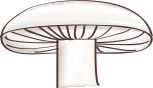
Pileus that can reach large dimensions, although this is an inconsistent character; some specimens may exceed 20 cm in diameter while others barely reach 7 or 8 cm. Its shape is convex or shell-shaped in its early stages, later it expands and may even become slightly depressed in the central area. Its surface is dry, glossy only when wet, smooth and tomentose when young, covered with scales at maturity; these scales acquire an ochraceous color. The cuticle is separable and white in color, sometimes slightly grayish, and the margin is involute during much of its development, finally expanded and not striate.
Lamellae very decurrent, neither very crowded nor distant, intermediate in spacing; they may sometimes be anastomosing at the attachment to the stipe. White in color for most of their growth, finally acquiring creamy or yellowish tones.
Stipe eccentric or lateral, solid, generally curved, short, whitish in color. Young specimens often exhibit an annular zone which is nothing but the remnants of the universal veil; it is fugacious, disappearing rapidly, and thus is not present in mature specimens.
Flesh thick; in young specimens it is softer, but becomes coriaceous with time. White in color. Its odor is fungoid and its taste sweet, pleasant in young specimens and less so in adults.
Habitat:
This is a species with a lignicolous habit, fruiting on old trunks or stumps of various broadleaf trees; we commonly observe it on oak or beech wood, although it has been reported on other tree species such as poplars and elms. It is a rather rare or at least infrequent species that appears mainly in autumn.
Observations:
Within a genus replete with species considered good edibles, the one presented here does not stand out for its culinary quality; in fact, old specimens are practically inedible. The only somewhat toxic species with which it can be confused is Pleurocybella porrigens, which shares the same color and shape; the differences are that it lacks a stipe, is smaller, and has more crowded lamellae. Other edible Pleurotus species also bear some resemblance, such as Pleurotus ostreatus, but none of them possess scales on the pileus.