
Pisolithus arhizus
Taxonomy
Main synonym
Common names
Pisolito tinctoreo, astaputz tintatzaile.
Geographic references:
Interactive map with data from GBIF.




Morphological Features:
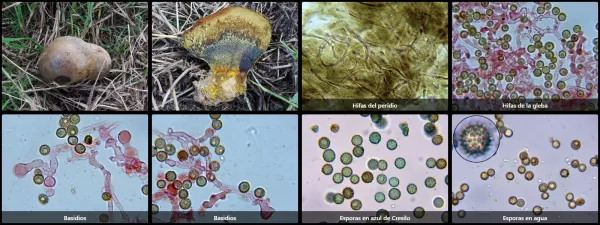
Fruiting body that at its maximum development can reach 15 cm in height, highly variable in shape; initially globose, later becoming elongated, and finally resembling a deformed trunk that releases a powdery substance from the apex. Its peridium is simple and quite smooth, hard, and variable in color within the ochre range.
Gleba composed of cavities of different colors, which resemble peridia; when immature they are yellowish or greenish, later turning dark brown, and finally becoming brown. Curiously, maturation proceeds from the basal region towards the apex; thus, if a specimen in the process of maturation is cross-sectioned, the three colors will be observable from bottom to top.
Stipe practically absent.
Flesh with an intense odor that contrasts with its mild flavor.
Habitat:
It can be found from spring onwards, always in sandy locations, slopes, paths, or forest tracks; it is very frequent and abundant.
Observations:
We consider it an unmistakable fungus, provided that whoever observes it recognizes it as a fungus rather than a fragment of tree trunk or root. Despite its appearance, it is considered edible, and furthermore possesses multiple applications in both dyeing and medicine.