
Picoa juniperi
Taxonomy
Main synonym
Common names
Negrillos, Monegrillos, Chivatas de las turmas.
Geographic references:
Interactive map with data from GBIF.


Morphological Features:
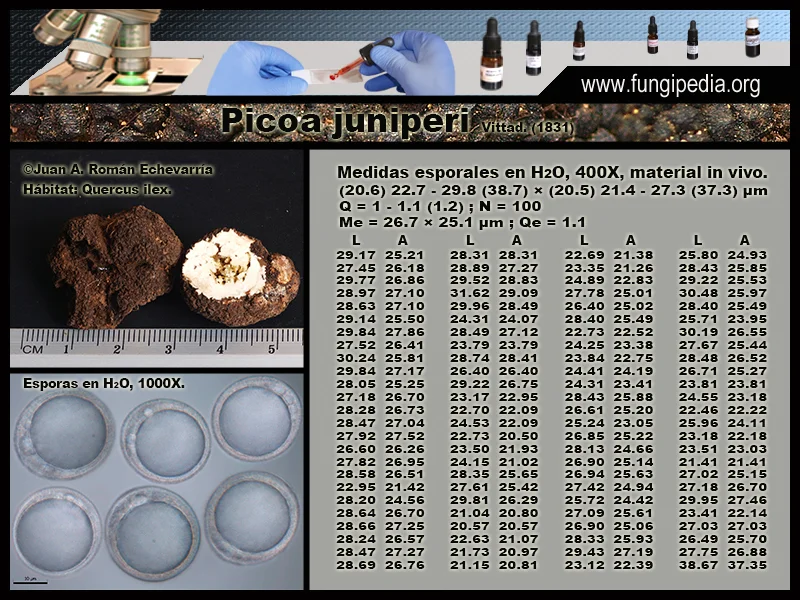
Fruiting body small in size and tuberiform, resembling a small subterranean tuber, with a referenced diameter ranging from 1 to 4 cm; in our collection, the largest specimen measured only 3 cm in diameter. They are typically quite spherical to oblong, generally regular in shape, bearing fissures (particularly basal ones), but with few protuberances. It exhibits a hard and fleshy external appearance despite its small size, with a very dark coloration that may be dark brown or outright blackish. Externally, it is markedly verrucose and generally resembles summer truffles.
Peridium hard and inseparable from the gleba, dark brown or typically black in color, composed of numerous polygonal warts that protrude slightly but feature flattened apical surfaces rather than pyramidal ones. Young specimens exhibit quite small and tightly packed warts; however, upon maturation, these warts tend to enlarge and become more deeply fissured. Microscopically, it is pseudoparenchymatous and bears structures resembling septate hairs.
Gleba Highly fleshy and compact, it exhibits a pure white coloration that contrasts markedly with the black peridium. The fertile portion retains its white color for an extended period, while sterile veins tend to become ochraceous with age; in old specimens, the entire gleba turns ochraceous. It contains more or less globose to subglobose asci bearing up to 8 spores. These spores are predominantly spherical, though sometimes not perfectly so, smooth when immature, and finely verrucose upon maturation. These details can be observed in the microscopy section of this entry.
Flesh which is nothing other than the gleba itself, compact and firm. It possesses an odor that bears no resemblance to true truffles, but is nonetheless quite pleasant, along with a flavor we also find agreeable, reminiscent of nuts, and exhibiting nuances similar to certain species of the genus Terfezia.
Habitat:
This is a species that is not excessively abundant but is widely distributed across the Iberian Peninsula, particularly in the south and east. It is typically associated with Cistaceae such as Helianthemum; in fact, it is colloquially referred to as "chivata" in relation to the highly sought-after Terfezia species, though this was not the case for our collection. We have verified that in the northern part of the peninsula, this species is quite common in mycorrhizal holm oak plantations established for the cultivation of Tuber melanosporum, which is the habitat where we located it. They begin to emerge in spring as the truffle season concludes; therefore, they do not harm these plantations due to the lack of temporal overlap. The specimens used for this entry were collected in the province of Burgos between April and late June.
Observations:
This species is characterized by a marked color contrast in cross-section, between a very dark or black peridium and a pure white, compact gleba. It is an edible species that can be consumed without issue, but of limited culinary quality; it bears no resemblance to true truffles and more closely resembles certain Terfezia species. Terfezia claveryi, with which it may share habitat, is a far superior edible to this species. There is some controversy regarding Picoa lefebvrei, with which there are virtually no microscopic differences, and which many authors consider to be the same species. It is morphologically very similar to the rare Picoa carthusiana, but easily distinguishable microscopically by its citriform spores.
Microscopy of Picoa juniperi