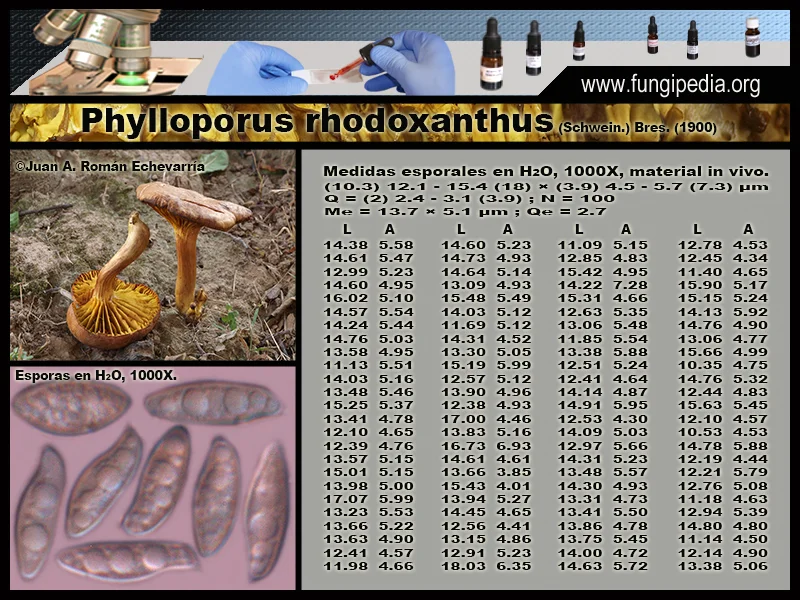
Phylloporus rhodoxanthus
Taxonomy
Main synonym
Common names
Not available
Geographic references:
Interactive map with data from GBIF.




Morphological Features:
Pileus 5 to 8 cm in diameter at maturity, initially convex but rapidly flattening, and may even become slightly depressed in the center. Brownish, more or less dark, sometimes with reddish tints. The cuticle is finely pubescent when young, but gradually loses this feature and becomes smooth. Margin regular, weakly incurved.
Lamellae markedly decurrent, yellow with a reddish-brown edge, thick and rather distant, forked or anastomosing. They may also be interpreted as lamellate tubes, given that this is a boletoid fungus. In any case, they are easily separable from the pileus.
Stipe generally central, sometimes eccentric, often curved and attenuated at the base. Light brown on a more yellowish background, closely resembling the stipes of Xerocomus.
Flesh rather scant, fibrous in the stipe, yellowish with pink or lilac tinges after standing for a while. Sweet taste and insignificant odor.
Habitat:
A very rare species that appears occasionally during summer months and autumn, associated with broad-leaved trees.
Observations:
This is a species worthy of comprehensive study, not merely microscopic but genetic. It is a transitional species, though its exact affinities remain unclear; microscopically it is allied to the subgenus Xerocomus, but macroscopically it resembles Gomphidius more than Paxillus. A mycological curiosity, this boletoid fungus with lamellae.
Microscopy of Phylloporus rhodoxanthus