
Pholiota gummosa
Taxonomy
Main synonym
Common names
Foliota gomosa, egur-ziza bidaiari.
Geographic references:
Interactive map with data from GBIF.


Morphological Features:
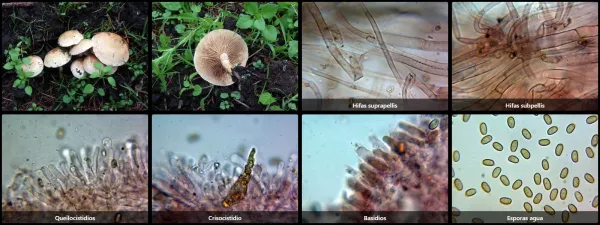
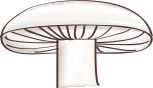
Pileus with a diameter reaching at most 5 cm, thus representing a rather small-statured mushroom; initially hemispherical, opening to become convex, and finally somewhat depressed, but retaining an obtuse umbo in the central area in many specimens. The cuticle is viscid in wet weather, yellowish or straw-colored with a noticeable greenish tint, and covered by ochraceous scales arranged more or less concentrically; these scales may disappear due to heavy rain. The margin is usually somewhat lighter and less scaly, bearing remnants of the universal veil in very young specimens that soon disappear.
Lamellae generally adnate and quite crowded, pale when young, whitish with a yellowish tint, later turning cream-colored, and acquiring a rusty-ochre tone upon sporulation.
Stipe elongated and cylindrical, slightly attenuate at the base, solid when young and later hollow; it has a whitish ground color, sometimes with a yellowish tint, becoming ochraceous from the base upwards with maturity. It usually bears irregular scales and a cortinate zone that stains with the spore color.
Flesh thin and somewhat elastic, cream-yellow in color; its odor is faint and barely perceptible, and its taste is mild.
Habitat:
A common species during autumn that may also appear at other times of the year. It typically fruits in fascicles on buried woody debris, giving the appearance of growing from the soil, or directly on wood, without a particular preference for any specific tree species.
Observations:
This common mushroom is easily identifiable by its fasciculate growth habit, characteristic scaling, and greenish hue; however, when these scales disappear, it may resemble other species. Flammula pinicola is similar, fruiting on pine wood with a more brownish-yellow and smooth cuticle. Pholiota lenta is larger and fruits solitarily; its cuticle becomes glutinous in wet weather. Due to its growth habit, it may also be confused with Hypholoma fasciculare, which bears greenish lamellae.